Art Institute of Chicago
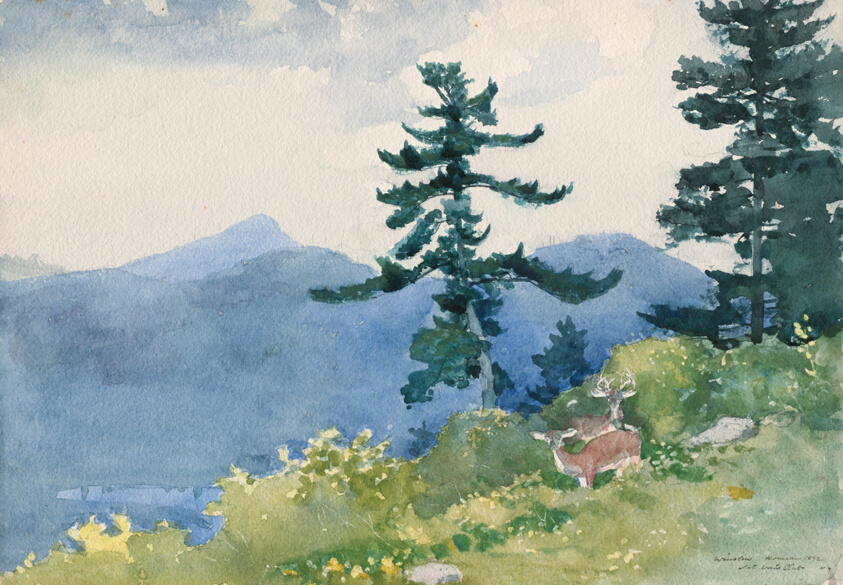
North Woods Club, Adirondacks (The Interrupted Tete-a-Tete)
Winslow HomerLinkedCulture matchlcp-bcddaaacf48f
- Date
- 1892
- Medium
- Watercolor, with rewetting, blotting and scraping, over graphite, on thick, moderately textured, ivory wove paper
- Culture
- United States
- Department
- Prints and Drawings
- Institution
- Art Institute of Chicago
- Object ID
- 113100
From the Art Institute of Chicago record
In numerous watercolors, Homer explored aspects of the controversy over deer hunting practices in the Adirondack region without overtly expressing his own opinion. In North Woods Club, Adirondacks (The Interrupted Tête-à-tête) , hunting is only hinted at in a subliminal way. Homer pictured two white-tailed deer, a doe and a buck, at the edge of a mountain meadow. Homer selected the exact moment when the deer become aware of another presence, the identity of whom is left to the viewer’s imagination. He juxtaposed a yellow-green flowering meadow with cool, purple-blue mountains, creating an entrancing summer vista. Yet Homer alluded to a less-benign narrative that would have been clear to his contemporaries. Two tall white pines stand silhouetted against the view, echoing the two deer. White pine had been dangerously over harvested in this period, and worry over its dwindling numbers in the Adirondacks paralleled concern for excessive hunting of deer. Homer drew the pine trees and deer carefully in pencil before adding watercolor, making sure that the distinctive characteristics of both threatened species would be clearly identifiable.
The authoritative record is held by Art Institute of Chicago. LinkedCulture surfaces this object and its connections; it does not alter institutional metadata.
Get printable QR codesHide QR codes
Open QR codes for this object page and the museum record. They stay collapsed until needed.
Provenance & credit
As published by the source institution. Coverage varies — not every institution's open-data feed includes ownership history.
- Credit line
- Mr. and Mrs. Martin A. Ryerson Collection
- Provenance
- The artist to his brother, Charles S. Homer, Jr. (1834–1917), New York, by 1910 [according to correspondence from Abigail Booth Gerdts to the Art Institute, February 10, 2007]. Charles W. Gould (1849–1931), New York, by 1915 [Brooklyn exh. cat. 1915]. Sold by Knoedler and Company, New York [stamp (not in Lugt), verso, in purple ink: M.K. & CO.//W.C. No…..1015], to Martin A. Ryerson (1856–1932), Chicago, November 11, 1915 [invoice]; given to the Art Institute, 1933.
Linked open data
Authority identifiers that link this record into the wider web of cultural data — stable references you can follow to the source.
- Object type
- AAT300033973
Part of a LinkedCulture topic
 American Watercolor Landscape Art
These objects are predominantly watercolor and drawing works by American artists depicting natural landscapes, outdoor recreational activities, and coastal or wilderness scenes from the 19th century.
63 objects from 3 institutions
Related across collections
Semantically similar works from Art Institute of Chicago and other institutions.