Art Institute of Chicago
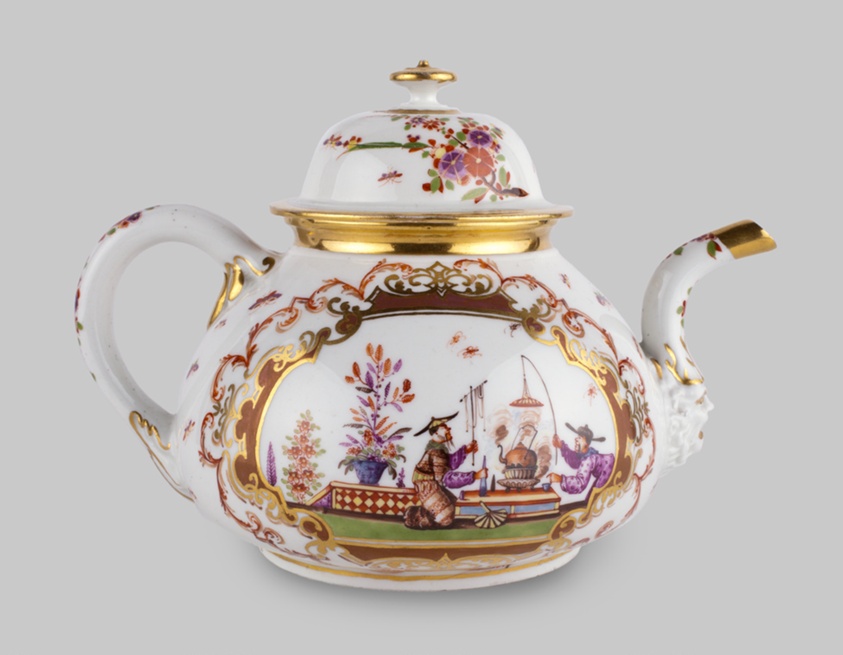
Teapot
Meissen Porcelain Manufactory (German, founded 1710)LinkedCulture matchlcp-dcc441afb176
- Date
- 1723/24
- Medium
- Hard-paste porcelain with polychrome enamels and gilding
- Culture
- Meissen
- Department
- Applied Arts of Europe
- Institution
- Art Institute of Chicago
- Object ID
- 117267
From the Art Institute of Chicago record
The Meissen Porcelain Manufactory was established in 1710 at Meissen, near Dresden in Germany. It was the first European factory to succeed in making hard-paste porcelain like that imported from China and Japan. From the 1720s, the chief painter at Meissen was Johann Gregorius Höroldt (1696–1775), who developed techniques to make the porcelain ground whiter, to better show off the range of enamel colors he introduced: greens, yellow, purples, and browns. 18th-century Europeans loved porcelain not only for its dazzling beauty, but also because it holds heat well, a useful feature in this period, when beverages like tea, coffee, and hot chocolate had become extremely fashionable. The scenes on this teapot are examples of chinoiserie, the imaginative Western interpretation of Chinese figures and motifs. Here, some Chinese men attract and play with birds, and two others engage in a tea ceremony, a witty reference to the function of the teapot. The lid, shaped like a Chinese temple bell, is decorated with Indianische Blumen (Indian flowers), a popular motif on German porcelain. This motif was actually Japanese in origin, an indication of how confused Westerners could be about Asian cultures at the time.
The authoritative record is held by Art Institute of Chicago. LinkedCulture surfaces this object and its connections; it does not alter institutional metadata.
Get printable QR codesHide QR codes
Open QR codes for this object page and the museum record. They stay collapsed until needed.
Provenance & credit
As published by the source institution. Coverage varies — not every institution's open-data feed includes ownership history.
- Credit line
- Gift of Mrs. Edgar J. Uihlein through the Antiquarian Society
Linked open data
Authority identifiers that link this record into the wider web of cultural data — stable references you can follow to the source.
- Object type
- AAT300386308
Part of a LinkedCulture topic
 18th-Century European Tea Ceramics
These objects are decorative ceramic vessels used for tea service and storage, predominantly from 18th-century European porcelain manufacturers including Worcester, Chelsea, Vienna, Sèvres, and Staffordshire, showcasing
158 objects from 5 institutions
Related across collections
Semantically similar works from Art Institute of Chicago and other institutions.