Art Institute of Chicago
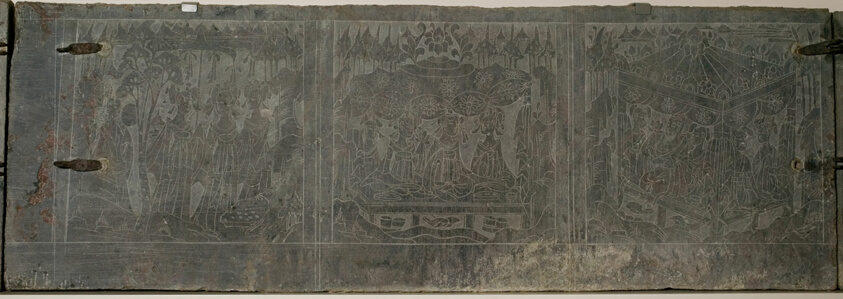
Panels from a Funerary Couch (Guanchuang)
ChinaLinkedCulture matchlcp-777a05c2acea
- Date
- Northern Wei dynasty (386–535); c. 525
- Medium
- Limestone
- Culture
- China
- Department
- Arts of Asia
- Institution
- Art Institute of Chicago
- Object ID
- 142531
From the Art Institute of Chicago record
These stone panels were originally assembled to enclose the back and short sides of a low, couchlike platform that held a coffin in a tomb. This “funerary couch” was probably supported along the front and back by two long stone slabs, each elevated on rectangular feet. Such a coffin platform may also have been partially enclosed in front by two stones carved to resemble gate towers, making the couch resemble the walled enclosure of a villa or a city. The original order of the Art Institute stones is not certain. Their present sequence is based on their relative lengths and pictorial compositions as well as on the alignment of the iron hinges. The left and right stones—one including a bullock cart, the other a horse with decorative trappings—may each have formed one short side of the funerary couch. The two stones between them—depicting scenes of figures under canopied platforms or umbrellas (both symbols of high status)—together may have formed the back of this structure. As reconstructed, these scenes present a symmetrical composition that is bracketed at either end by figures facing inward. Such linear drawings in stone enable us to imagine the appearance of early horizontal scroll paintings. Eight framed figural compositions are engraved into the inner surface of these smoothly polished stones. The figures’ proportions and clothing are characteristic of early sixth-century Chinese styles, as known from datable tomb figurines, stone carvings, and rare surviving paintings. Except for the bearded gentlemen and those wearing baggy trousers and small “official” caps, with or without projecting wings, most of these figures seem to depict women. Not all figures, however, can be clearly distinguished as to sex, since long robes with wide collars, high sashes, and flowing sleeves were worn by aristocratic men and women alike, who also shared a hairstyle of upswept side buns. These figures are grouped in stagelike settings—hills, mountains, trees and bushes with decorative foliage patterns, and windblown cloudbands—which suggest what early pictorial landscapes may have looked like.
The authoritative record is held by Art Institute of Chicago. LinkedCulture surfaces this object and its connections; it does not alter institutional metadata.
Get printable QR codesHide QR codes
Open QR codes for this object page and the museum record. They stay collapsed until needed.
Provenance & credit
As published by the source institution. Coverage varies — not every institution's open-data feed includes ownership history.
- Credit line
- Ardith Lauerman Fund; Louise Lutz, Samuel M. Nickerson and Russell Tyson endowments
Linked open data
Authority identifiers that link this record into the wider web of cultural data — stable references you can follow to the source.
- Object type
- AAT300234126
Related across collections
Semantically similar works from Art Institute of Chicago and other institutions.