Art Institute of Chicago
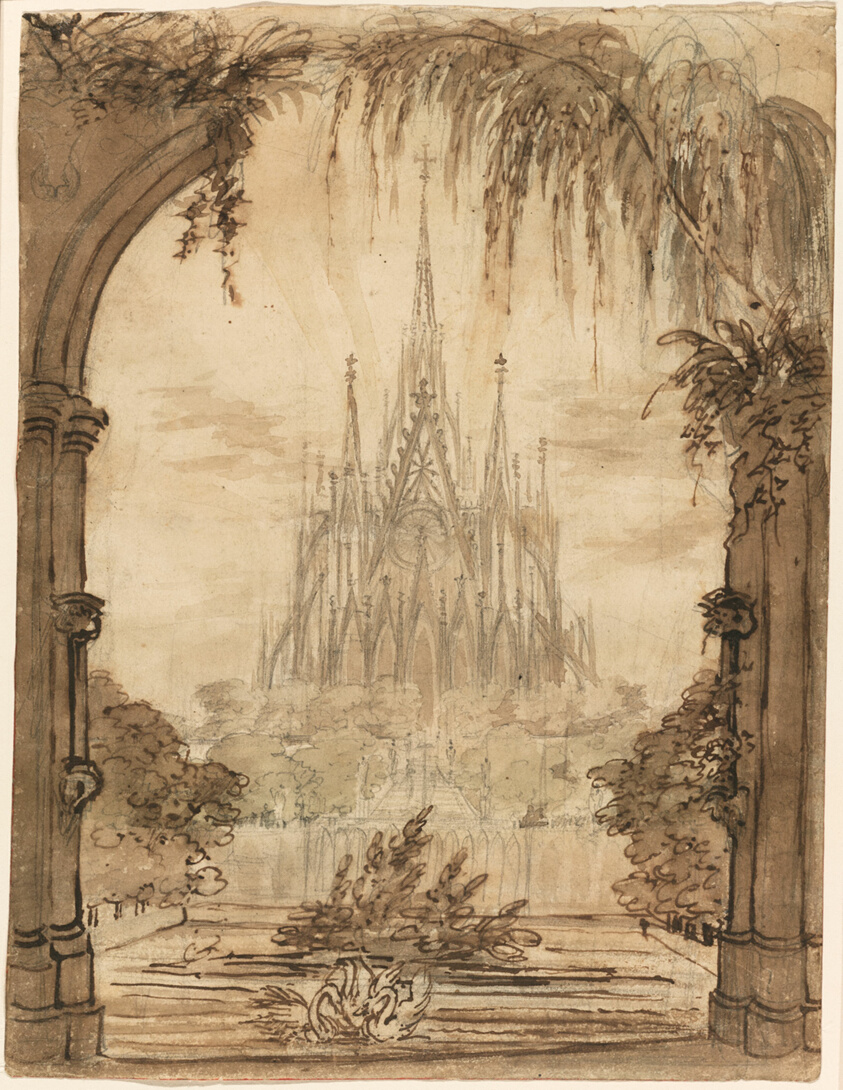
Gothic Cathedral Behind a Pond with Swans
Karl Friedrich SchinkelLinkedCulture matchlcp-9233a60898f9
- Date
- 1810/15
- Medium
- Pen and brush and brown wash, with brush and brown wash and watercolor, over graphite, on cream wove paper
- Culture
- Germany
- Department
- Prints and Drawings
- Institution
- Art Institute of Chicago
- Object ID
- 144370
From the Art Institute of Chicago record
Faced with a dearth of architectural commissions in French-occupied Berlin after 1806, the architect Karl Friedrich Schinkel produced depictions of imagined architecture. Through these nostalgic concoctions Schinkel championed the Germanic Middle Ages by reviving a Gothic style of architecture over his more customary Neoclassical mode. Taking advantage of national sentiment, he found a market of buyers who longed for images of a simpler time. Schinkel’s own inscription from one of his contemporary lithographs could describe this work: an “attempt to express the lovely nostalgic sadness that fills the heart when the sound of the service emanates from the church.”
The authoritative record is held by Art Institute of Chicago. LinkedCulture surfaces this object and its connections; it does not alter institutional metadata.
Get printable QR codesHide QR codes
Open QR codes for this object page and the museum record. They stay collapsed until needed.
Provenance & credit
As published by the source institution. Coverage varies — not every institution's open-data feed includes ownership history.
- Credit line
- Gift of Dorothy Braude Edinburg to the Harry B. and Bessie K. Braude Memorial Collection
- Provenance
- Private Collection, Berlin; Christie’s, London, October 11, 1995, lot 1. Sold by Gertrud Rudigier Kunsthandel, Munich, to Dorothy Edinburg, Brookline, MA., 1996; given to the Art Institute of Chicago, 2013.
Linked open data
Authority identifiers that link this record into the wider web of cultural data — stable references you can follow to the source.
- Object type
- AAT300033973
Related across collections
Semantically similar works from Art Institute of Chicago and other institutions.