Art Institute of Chicago
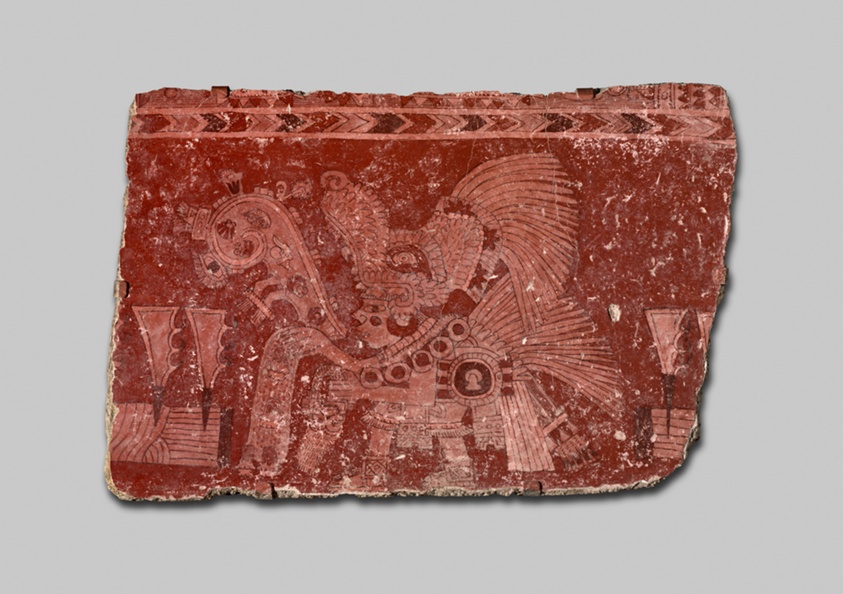
Mural Fragment Depicting a Maguey Bloodletting Ritual
TeotihuacanLinkedCulture matchlcp-f52bd136b696
- Date
- 500–600 CE
- Medium
- Lime plaster with mineral pigment
- Culture
- Teotihuacán
- Department
- Arts of the Americas
- Institution
- Art Institute of Chicago
- Object ID
- 14968
From the Art Institute of Chicago record
The ancient Mexican city of Teotihuacan was once the largest city in all of the Americas. The pomp and color of this great city were expressed most distinctively through its monumental architecture. Facades of pyramids and interiors of palaces, temples, and homes were frequently decorated with splendid frescoes. The fragment shown here was part of a cycle painted on the interior walls of an aristocratic palace. It shows a rain priest walking or processing in profile and wearing an elaborate headdress and costume. His speech-scroll, adorned with seashells and plants, indicates that he is praying for water and agricultural prosperity, which were highly valued in his society. Meaning “place of the gods,” Teotihuacan was the largest religious, military, and trading city in the Americas between A.D. 200 and 650, and it was inhabited by over one hundred thousand people at its peak. Designed with colossal pyramids and ritual plazas, the metropolis was built on a cosmologically oriented grid plan that embraced residential and manufacturing districts. This richly symbolic fragment from a Teotihuacan wall fresco depicts a ceremony that took place once every fifty-two years, a “century” in the ancient Mexican calendar system. A priest stands before a tied bundle of reeds representing the completion of a cycle of time. The bundle is impaled by the spiny points of maguey cactus leaves, with which the priestly protagonist of the scene has pricked himself to provide a blood offering. Water symbols in the form of shells and flowers are depicted within the speech-scroll curling from the priest’s mouth. Additional flowers and water are sprinkled from one of the priest’s hands, while in the other he holds an incense bag. Corresponding to the chants of a religious litany, this complex image was repeated with others on the walls of a chamber as a prayer of thanksgiving and for the renewal of agricultural fertility.
The authoritative record is held by Art Institute of Chicago. LinkedCulture surfaces this object and its connections; it does not alter institutional metadata.
Get printable QR codesHide QR codes
Open QR codes for this object page and the museum record. They stay collapsed until needed.
Provenance & credit
As published by the source institution. Coverage varies — not every institution's open-data feed includes ownership history.
- Credit line
- Ada Turnbull Hertle Fund
- Provenance
- Galerie Signoret-James, Mexico City, by Oct. 26, 1962 [this and the following according to incoming receipt RX4078, Oct. 26, 1962; copy in curatorial object file]; sold through Everett D. Rassiga to the Art Institute of Chicago, 1962.
Linked open data
Authority identifiers that link this record into the wider web of cultural data — stable references you can follow to the source.
- Object type
- AAT300190691
Related across collections
Semantically similar works from Art Institute of Chicago and other institutions.