Art Institute of Chicago
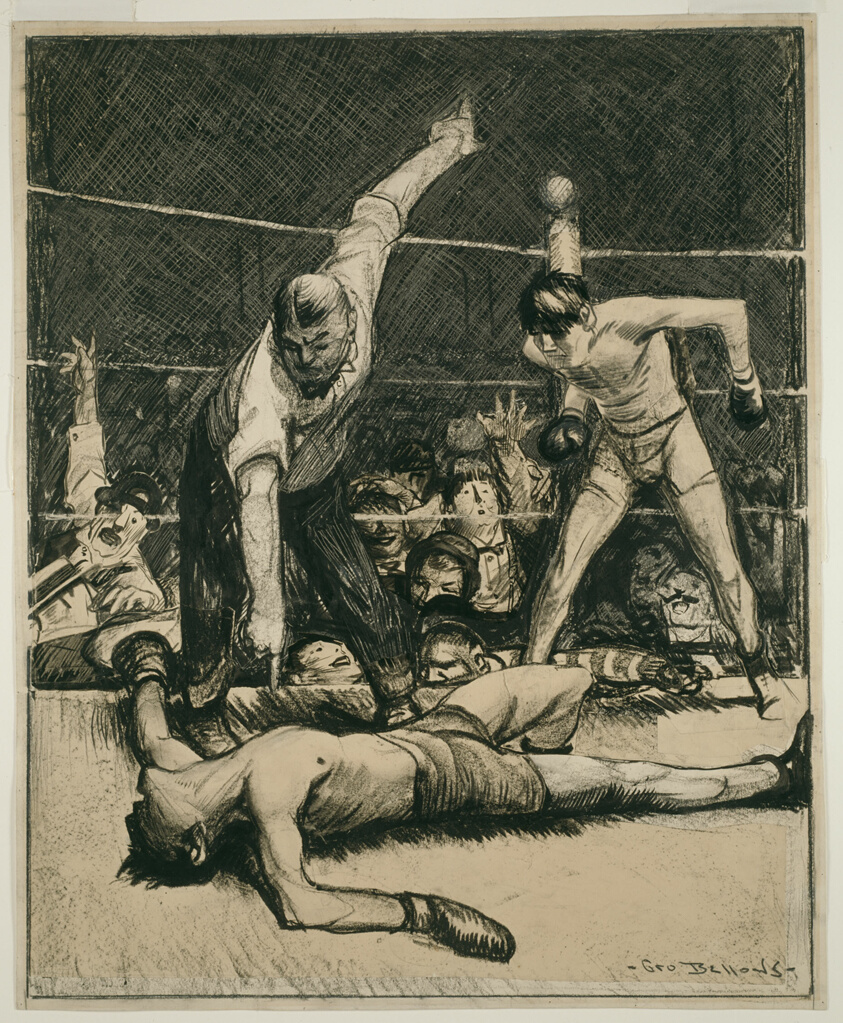
Counted Out
George Wesley BellowsLinkedCulture matchlcp-2d2c387fd640
- Date
- 1912
- Medium
- Lithographic crayon and charcoal, with brush and black ink, scraping and smudging, over touches of graphite on cut and pieced cream wove papers, laid down on ivory wove paper
- Culture
- United States
- Department
- Prints and Drawings
- Institution
- Art Institute of Chicago
- Object ID
- 150788
From the Art Institute of Chicago record
A native of Ohio, George Wesley Bellows studied early on with Robert Henri, a proponent of urban realism. Encouraged by Henri, Bellows sought out subjects that represented the vitality of the everyday lives of New Yorkers. His first studio was located across the street from Sharkey’s Athletic Club, where he became an avid boxing fan. A number of dramatic paintings, such as his 1909 Stag at Sharkey’s (now in the Cleveland Museum of Art), established his reputation as the preeminent painter of this quintessential urban subject. In 1913 American Magazine commissioned Bellows to produce four drawings to accompany an article by L. C. Moíse recounting the fight between former lightweight champion Jimmy Nolan and his nemesis, Tornado Black. Counted Out is one of the four. When the fight started, the two men could hardly contain their hatred for one another, and the energy inside the ring fueled the frenetic audience. Just before the third round, Nolan realized he had “lost his punch,” and did everything possible to fend off Black’s fierce attacks. When he finally mustered his “last ounce,” he prevailed, and the “Tornado dropped senseless to the floor.” The four drawings together illustrate the entire event; the Art Institute’s sheet depicts Nolan’s moment of triumph. We don’t know whether Bellows actually attended the fight, but he faithfully adhered to many visual details in Moíse’s article, such as the long scar on Black’s face and Nolan’s disfigured ear, overly pronounced jaw, and dramatic pose. For this drawing, Bellows used lithographic crayon, a medium he preferred for its ability to create rich gradations of black. He emphasized the theatricality of the scene by placing the viewer inside the ropes, using dramatic lighting that heightens certain faces in the crowd while obscuring others, and by exaggerating gesture, such as the referee’s wildly splayed arms and Black’s crucified pose. Finally, Bellows constructed the composition around a strong pyramidal shape formed by the three protagonists, which draws us into the action and directs our focus.
The authoritative record is held by Art Institute of Chicago. LinkedCulture surfaces this object and its connections; it does not alter institutional metadata.
Get printable QR codesHide QR codes
Open QR codes for this object page and the museum record. They stay collapsed until needed.
Provenance & credit
As published by the source institution. Coverage varies — not every institution's open-data feed includes ownership history.
- Credit line
- Gift of Dorothy Braude Edinburg to the Harry B. and Bessie K. Braude Memorial Collection
- Provenance
- Estate of the artist, from 1925. Frank Rehn Galleries, New York, c. 1928. Sam A. Lewisohn (1884–1951), New York, c. 1928; by descent to his wife, Margaret Seligman Lewisohn (1895–1954), New York; by descent to her daughter, Mrs. Virginia Kahn [all provenance Washington D.C. 1982–83]. Sold by Robert M. Light, Boston, to Dorothy Braude Edinburg, Brookline, MA., June 1, 1966; given to the Art Institute, 1998.
Linked open data
Authority identifiers that link this record into the wider web of cultural data — stable references you can follow to the source.
- Object type
- AAT300033973
Related across collections
Semantically similar works from Art Institute of Chicago and other institutions.