Art Institute of Chicago
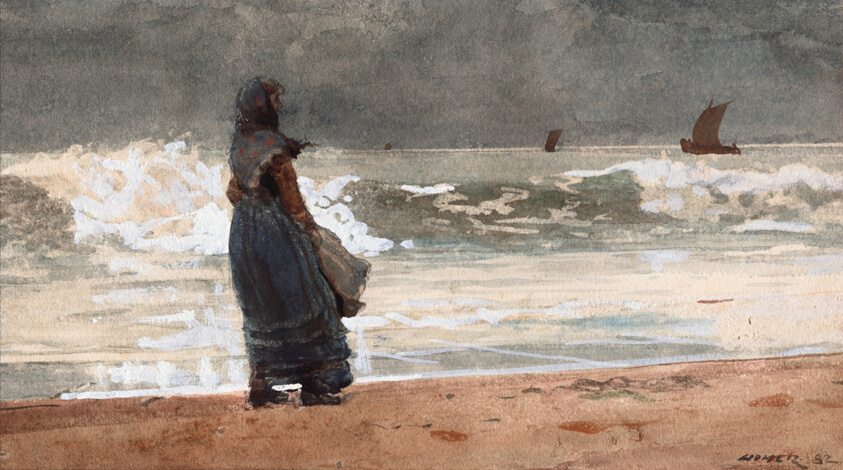
The Watcher, Tynemouth
Winslow HomerLinkedCulture matchlcp-bcddaaacf48f
- Date
- 1882
- Medium
- Transparent and opaque watercolor, with rewetting, blotting, and scraping, heightened with gum glaze, over graphite, on moderately thick, slightly textured, cream wove paper (all edges trimmed)
- Culture
- United States
- Department
- Prints and Drawings
- Institution
- Art Institute of Chicago
- Object ID
- 16840
From the Art Institute of Chicago record
During his sojourn in England, from 1881 to 1882, Homer settled in the small fishing village of Cullercoats, located about two miles from the city of Tynemouth. He often drew and painted the women of the village, as they watched and waited on the shore, eyes always trained on the frequently treacherous sea. The Watcher, Tynemouth emphasizes the woman's loneliness and anxiety as she faces the raw forces of nature. Homer chose to represent the woman with her back to the viewer. She is clad in dark blue and reddish-brown clothing, and her face is obscured by a headscarf, so as to shield her from probing eyes. The muted palette of this watercolor—overcast blue-gray sky, murky green and blue waves—exaggerates the stark whiteness of the foamy caps on the waves. Their peaks punctuate the horizon line, as do the sails of the two boats in the distance.
The authoritative record is held by Art Institute of Chicago. LinkedCulture surfaces this object and its connections; it does not alter institutional metadata.
Get printable QR codesHide QR codes
Open QR codes for this object page and the museum record. They stay collapsed until needed.
Provenance & credit
As published by the source institution. Coverage varies — not every institution's open-data feed includes ownership history.
- Credit line
- Mr. and Mrs. Martin A. Ryerson Collection
- Provenance
- The artist to his brother, Charles S. Homer, Jr. (1834–1917), New York, by 1910 [according to correspondence from Abigail Booth Gerdts to the Art Institute, February 10, 2007]. Charles W. Gould (1849–1931), New York, by 1915 [Brooklyn exh. cat. 1915]. Sold by Knoedler and Company, New York, to Martin A. Ryerson (1856–1932), Chicago, November 11, 1915 [invoice]; given to the Art Institute, 1933.
Linked open data
Authority identifiers that link this record into the wider web of cultural data — stable references you can follow to the source.
- Object type
- AAT300033973
Part of a LinkedCulture topic
 American Watercolor Landscape Art
These objects are predominantly watercolor and drawing works by American artists depicting natural landscapes, outdoor recreational activities, and coastal or wilderness scenes from the 19th century.
63 objects from 3 institutions
Related across collections
Semantically similar works from Art Institute of Chicago and other institutions.