Art Institute of Chicago
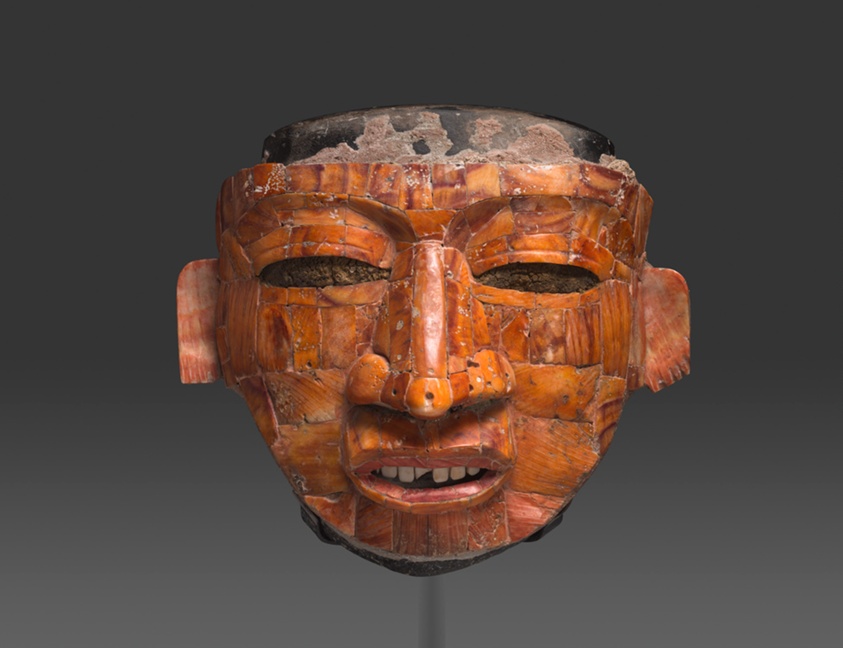
Face
Artist unknown (Teotihuacan)LinkedCulture matchlcp-720adf61c688
- Date
- 300–600 CE
- Medium
- Stone, spondylus shell, and stucco
- Culture
- Teotihuacán
- Department
- Arts of the Americas
- Institution
- Art Institute of Chicago
- Object ID
- 212967
From the Art Institute of Chicago record
Teotihuacan, the ruins of which are located near Mexico City, was one of the largest and most complex cities in the world during the first millennium AD. Although this mask shares features common to others from the city—a broad forehead, prominent nose, receding chin, and widely spaced cheekbones—it is subtly unique, indicating that it may represent a stylized portrait. Tied to wooden armatures adorned with feathers, jewelry, and garments, such masks were displayed in residential compounds and temples where they were the focus of rituals commemorating ancestors who acted as intermediaries between the living and the deified forces of nature. An older, recut stone mask was covered with mosaic tiles made from the inner layer of spondylus shell imported from the Pacific coast. The use of this exotic material suggests the far-reaching power, author¬ity, and wealth of Teotihuacan. Spondylus was also considered sacred, associating this mask and the individual it honors with the generative power of lakes, rivers, and the sea.
The authoritative record is held by Art Institute of Chicago. LinkedCulture surfaces this object and its connections; it does not alter institutional metadata.
Get printable QR codesHide QR codes
Open QR codes for this object page and the museum record. They stay collapsed until needed.
Provenance & credit
As published by the source institution. Coverage varies — not every institution's open-data feed includes ownership history.
- Credit line
- Through prior gifts of Mr. and Mrs. Arthur M. Wood and Mr. and Mrs. William E. Hartmann; Robert Allerton Trust Fund; through prior gifts of Ethel and Julian R. Goldsmith and Mr. and Mrs. Samuel A. Marx; Morris L. Parker Fund; purchased with funds provided by Cynthia and Terry Perucca and Bill and Stephanie Sick; Wirt D. Walker Trust, Bessie Bennett, and Elizabeth R. Vaughn funds; purchased with funds provided by Rita and Jim Knox and Susan and Stuart Handler; Edward E. Ayer Fund in memory of Charles L. Hutchinson and Gladys N. Anderson Fund; purchased with funds provided by Terry McGuire; Samuel P. Avery Endowment Fund; Charles U. Harris Endowed Acquisition Fund
- Provenance
- Private collection, Mexico, then United States, 1959 [imported to US in 1959 according to customs form dated 3/9/59 in curatorial file]; sold to the Art Institute of Chicago, 2012.
Linked open data
Authority identifiers that link this record into the wider web of cultural data — stable references you can follow to the source.
- Object type
- AAT300301253
Related across collections
Semantically similar works from Art Institute of Chicago and other institutions.