Art Institute of Chicago
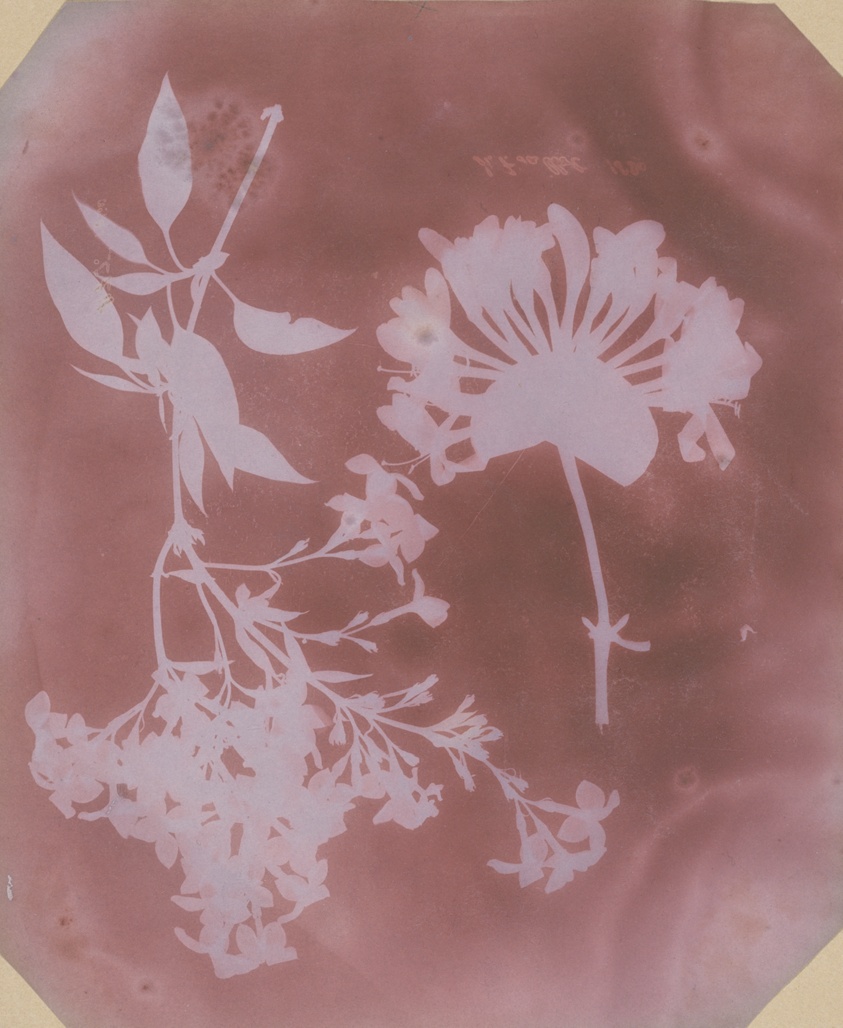
Two Plant Specimens
William Henry Fox TalbotLinkedCulture matchlcp-cbeb0adf94af
- Date
- 1839
- Medium
- Photogenic drawing
- Culture
- England
- Department
- Photography and Media
- Institution
- Art Institute of Chicago
- Object ID
- 38930
From the Art Institute of Chicago record
Contained within this haunting and poetic image is the seed of photography: the possibility of creating a negative from which an unlimited number of positives can be made. William Henry Fox Talbot produced this image by placing botanical specimens on sensitized paper and exposing them to light. He made this groundbreaking discovery after his 1833 honeymoon on the shores of Lake Como, in Lombardy, Italy. Frustrated by his inability to draw his Italian surroundings accurately, Talbot recalled the fleeting images of external objects that appeared within a camera lucida (an optical prism that creates a superimposed image on an artist’s drawing surface) and wondered how he could make them “imprint themselves durably, and remain fixed upon the paper.” What resulted, two years later, were the first camera negatives. Unveiled in 1839 and called photogenic drawing, Talbot’s process was perfected two years later into the calotype (from the Greek word kalos , meaning “beautiful”). By the end of his life, Talbot—whose far-ranging interests included mathematics, botany, etymology, and ancient Assyria—had also discovered the basis of halftone printing, obtained twelve patents, and authored seven books, including one of the first photographically illustrated books, The Pencil of Nature (1844).
The authoritative record is held by Art Institute of Chicago. LinkedCulture surfaces this object and its connections; it does not alter institutional metadata.
Get printable QR codesHide QR codes
Open QR codes for this object page and the museum record. They stay collapsed until needed.
Provenance & credit
As published by the source institution. Coverage varies — not every institution's open-data feed includes ownership history.
- Credit line
- Edward E. Ayer Endowment in memory of Charles L. Hutchinson
Linked open data
Authority identifiers that link this record into the wider web of cultural data — stable references you can follow to the source.
- Object type
- AAT300046300
Related across collections
Semantically similar works from Art Institute of Chicago and other institutions.