Art Institute of Chicago
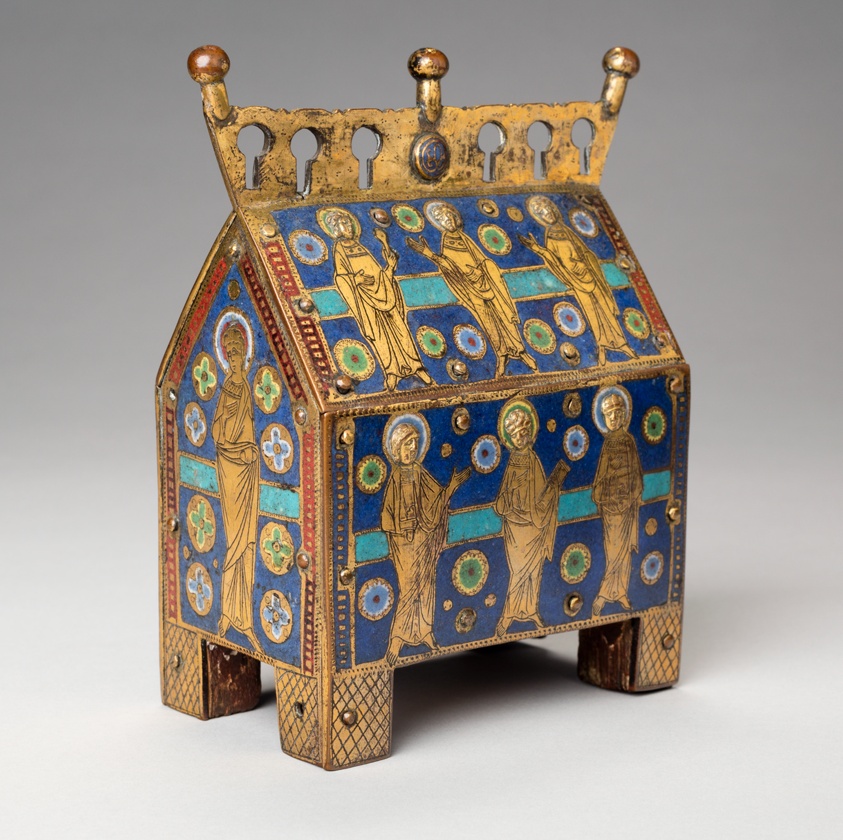
Reliquary Casket
French; LimogesLinkedCulture matchlcp-bde2bba24a5d
- Date
- c. 1200
- Medium
- Gilt copper, champlevé enamel over wood core
- Culture
- Limoges
- Department
- Applied Arts of Europe
- Institution
- Art Institute of Chicago
- Object ID
- 46253
From the Art Institute of Chicago record
This reliquary casket, with its vibrantly colored enamel fields, is typical of the objects created at the prolific workshops in and around Limoges, France, in the Middle Ages. By the end of the 12th century, opus lemovicense (Limoges work) had gained an international reputation, and documentary sources indicate that ornamentation with enamel was considered as precious as that with gemstones. Six figures of saints appear on the front panels of the casket, while a single saint is shown standing on each end panel. This decidedly nonspecific iconography would have made the casket appropriate for any number of churches and allowed it to house the relics of virtually any saint.
The authoritative record is held by Art Institute of Chicago. LinkedCulture surfaces this object and its connections; it does not alter institutional metadata.
Get printable QR codesHide QR codes
Open QR codes for this object page and the museum record. They stay collapsed until needed.
Provenance & credit
As published by the source institution. Coverage varies — not every institution's open-data feed includes ownership history.
- Credit line
- Kate S. Buckingham Endowment
- Provenance
- Harry Fuld (1879–1932), Frankfurt, before 1932 [see Bloch 1992]; by descent to his widow, Lucie Mayer-Fuld (née Cajzago) (d. 1966), Frankfurt, Berlin, and New York, 1932–42 [according to incoming shipping receipt in curatorial file]; sold through Raphael Stora, New York, to the Art Institute for $4,000, 1942 [according to incoming shipping receipt, mentioned above].
Linked open data
Authority identifiers that link this record into the wider web of cultural data — stable references you can follow to the source.
- Object type
- AAT300411548
Related across collections
Semantically similar works from Art Institute of Chicago and other institutions.