Art Institute of Chicago
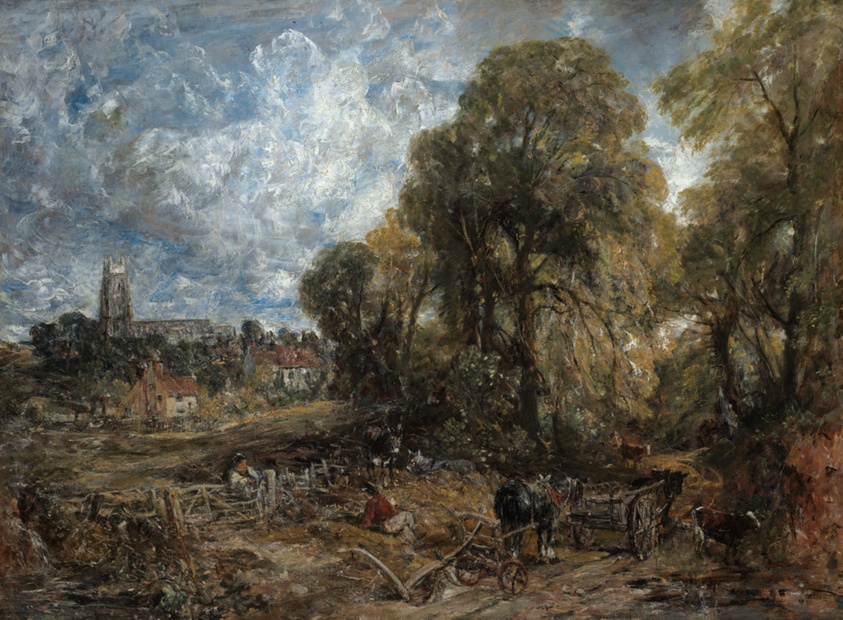
Stoke-by-Nayland
John Constable (English, 1776-1837)LinkedCulture matchlcp-f5b007f78966
- Date
- 1836
- Medium
- Oil on canvas
- Culture
- England
- Department
- Painting and Sculpture of Europe
- Institution
- Art Institute of Chicago
- Object ID
- 4758
From the Art Institute of Chicago record
“What say you to a summer morning?” John Constable wrote of this painting in a letter to a friend. Even after many years living in London, Constable continued to portray the countryside, dear to him from boyhood. Stoke-by-Nayland lies a few miles from his native village of East Bergholt in Suffolk. In this view, he divided the canvas between a brilliant, airy vista toward the hamlet on the left and a shady, tunnel-like country lane leading off to the right. Constable explained in his letter that the painting depicted a specific time, a morning in “July or August, at eight or nine o’clock, after a slight shower during the night, to enhance the dews in the shadowed part of the picture.” The artist emphasized the abundance of water through his painting technique, flecking the surface with white highlights to create an effect of sparkling wetness. Here, the whole scene appears dewy, with a stream and puddles in the foreground and a central tree that droops from the weight of rainwater, emphasizing the fertile land. Painted as much with a palette knife as with brushes, Stoke-by-Nayland lacks the finish of pictures Constable exhibited publicly; it was meant as a full-scale sketch for a work that he never realized. Nonetheless, this canvas seems to capture Constable’s delight in freely scribbling and scraping the image into existence—what it lacks in detail it gains in atmosphere. The roughness of the surface evokes the textures of real landscape, and the coexistence of natural and built elements in the scene embodies an ideal of harmony indicative of Constable’s vision of rural England.
The authoritative record is held by Art Institute of Chicago. LinkedCulture surfaces this object and its connections; it does not alter institutional metadata.
Get printable QR codesHide QR codes
Open QR codes for this object page and the museum record. They stay collapsed until needed.
Provenance & credit
As published by the source institution. Coverage varies — not every institution's open-data feed includes ownership history.
- Credit line
- Mr. and Mrs. W. W. Kimball Collection
- Provenance
- Sold, the artist’s estate sale, Foster and Sons, London, May 16, 1838, lot 40 together with a sketch of the Opening of Waterloo Bridge to Joy [Graves 1918 and Day 1968]. Miss Morris; sold June 26, 1860 lot 108 to Cox [annotated sale cat. in the Nederlands Instituut voor Kunstgeschiedenisn, The Haag; copy in curatorial object file. See also Redford 1888]. Jonathan Nield (1790–1887), Dunster House, Rochdale, England; sold, Christie’s, London, May 3, 1879, lot 13 to Permain [annotated sale cat. in curatorial object file. See also Redford 1888, Graves 1918 and Day 1968]. Sir Frederick Thorpe Mappin (1821–1910); sold, his estate sale, Christie’s, London, June 17, 1910, lot 14 to Arthur J. Sulley & Company, London [this and the following according to Knoedler Stock Book 5, no. 12466, Getty Research Institute, Los Angeles; copy in curatorial object file. See also annotated sale cat. in curatorial object file ]; sold to Knoedler and Company, New York, May 1, 1911; sold to Mrs. William Wallace Kimball (died 1921), Chicago, July 11, 1911; given to the Art Institute of Chicago, 1922.
Linked open data
Authority identifiers that link this record into the wider web of cultural data — stable references you can follow to the source.
- Object type
- AAT300033618
Related across collections
Semantically similar works from Art Institute of Chicago and other institutions.