Art Institute of Chicago
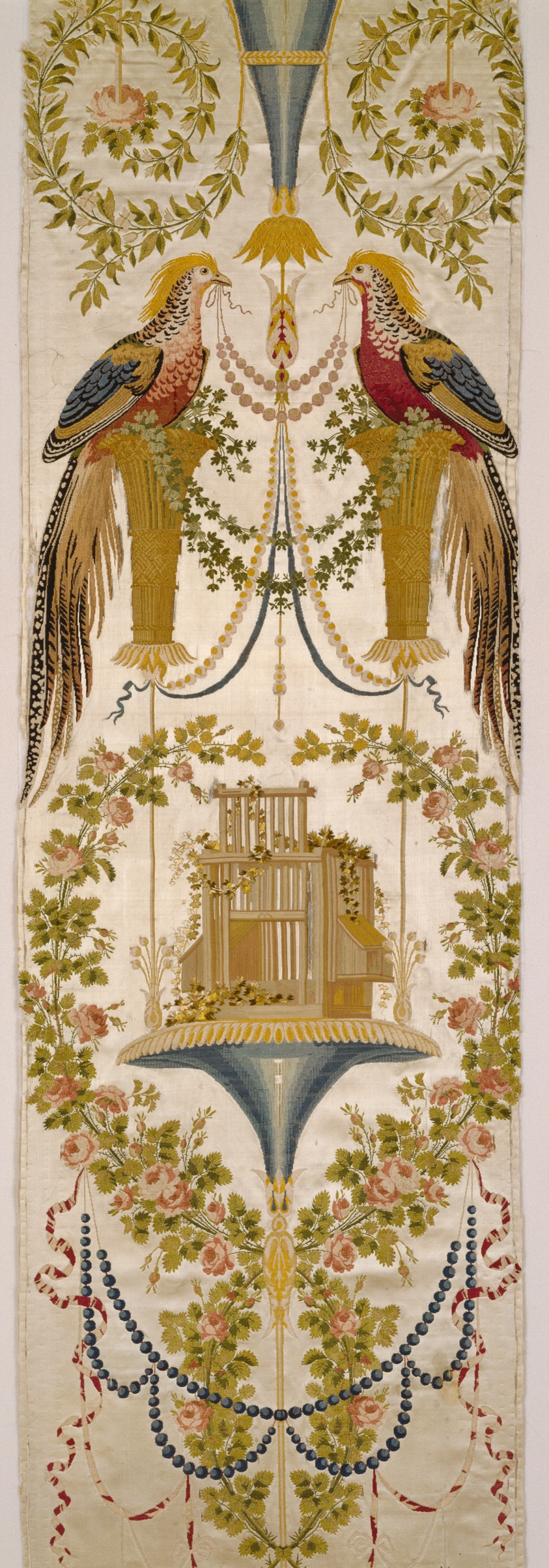
The Pheasants from the "Verdures of the Vatican" Series
Designed by Jean Démosthène Dugourc (French, 1749–1825)LinkedCulture matchlcp-cccf277e5223
- Date
- c. 1799
- Medium
- Silk, satin weave with plain interlacings of secondary binding warps and brocading wefts; embroidered with silk in chain (tambour work) and satin stitches
- Culture
- Lyon
- Department
- Textiles
- Institution
- Art Institute of Chicago
- Object ID
- 52679
From the Art Institute of Chicago record
Perhaps the last great name connected with the French silk industry in the late eighteenth and early nineteenth centuries is that of Jean-Démosthène Dugourc. A designer of costumes and stage decorations for the French opera, he was also the superintendent of buildings and designer of Garde-Meuble for the Duc d’Orléans. Dugourc was the most outstanding interior decorator of his time, and from 1774 to 1790 he produced designs for the silk manufacturer Camille Pernon of Lyon. Educated in Italy for a time, Dugourc was familiar with the classical antique motifs that Raphael had revived in his fresco decorations for the Vatican Loggie, part of the papal palace in Rome. In fact, the French designer titled a group of textile patterns Verdures of the Vatican. The Pheasants , which was designed for the Spanish royal palace in Madrid, is part of this series. The elaborate composition encompasses a lavish, symmetrical interplay of birds, baskets, strings of pearls, garlands, and ribbons—all realized with the excellence of workmanship that made French silks so desirable.
The authoritative record is held by Art Institute of Chicago. LinkedCulture surfaces this object and its connections; it does not alter institutional metadata.
Get printable QR codesHide QR codes
Open QR codes for this object page and the museum record. They stay collapsed until needed.
Provenance & credit
As published by the source institution. Coverage varies — not every institution's open-data feed includes ownership history.
- Credit line
- Purchased with funds provided by Mrs. Chauncey B. Borland
Linked open data
Authority identifiers that link this record into the wider web of cultural data — stable references you can follow to the source.
- Object type
- AAT300014063
Related across collections
Semantically similar works from Art Institute of Chicago and other institutions.