Art Institute of Chicago
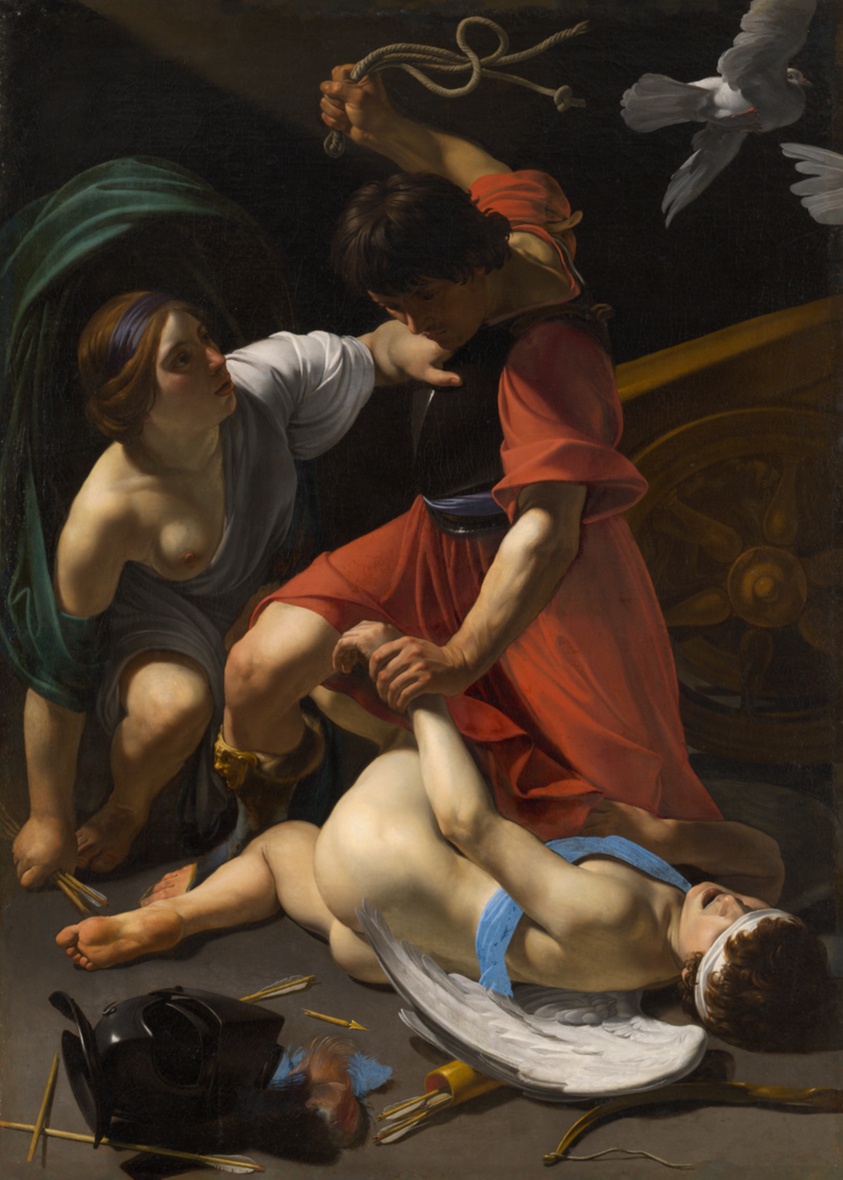
Cupid Chastised
Bartolomeo Manfredi (Italian, 1582–1622)LinkedCulture matchlcp-af866b855393
- Date
- 1613
- Medium
- Oil on canvas
- Culture
- Italy
- Department
- Painting and Sculpture of Europe
- Institution
- Art Institute of Chicago
- Object ID
- 59847
From the Art Institute of Chicago record
Cupid Chastised depicts a moment of high drama: Mars, the god of war, violently whips the young boy, Cupid, as punishment for embroiling the god in an affair with the boy’s mother, Venus, the goddess of love. Venus tries in vain to stop the beating. Surrounded by darkness, the three figures are boldly illuminated from the left, intensifying the composition’s dynamism and impact. The physicality of the figures conveys the violent discord of the scene: the crouching, wide-eyed Venus; the furious, muscular Mars; and Cupid, whose naked flesh and recumbent position render him particularly vulnerable. On one level a tale of interpersonal conflict, the story also symbolizes the eternal conflict between love and war. Bartolomeo Manfredi chose to depict ordinary individuals in scenes from the Bible and Greek and Roman mythology. In so doing, he was following the example of the revolutionary early seventeenth-century artist Caravaggio, who had demonstrated to an entire generation of European artists that such lofty themes could be transformed into events experienced by ordinary people. Manfredi began his career as an artist in Rome by producing copies of Caravaggio’s works, including a painting (now lost) that likely inspired Cupid Chastised, commissioned by Caravaggio’s first major patron, the influential collector Cardinal Francesco Maria del Monte. Manfredi carried the Caravaggesque style forward, assimilating and adapting elements of the older artist’s approach, like the naturalistic portrayal of studio models in mythological roles and the dramatic contrast of light and shadow, known in Italian as chiaroscuro .
The authoritative record is held by Art Institute of Chicago. LinkedCulture surfaces this object and its connections; it does not alter institutional metadata.
Get printable QR codesHide QR codes
Open QR codes for this object page and the museum record. They stay collapsed until needed.
Provenance & credit
As published by the source institution. Coverage varies — not every institution's open-data feed includes ownership history.
- Credit line
- Charles H. and Mary F. S. Worcester Collection
- Provenance
- Commissioned by Agostino Chigi (died 1644), Siena, through the agency of Giulio Mancini in March 1613; painting completed by October 1613 [see Wazbinski, 1996]; by descent in the Chigi family, Siena and Rome [recorded in 1644 Chigi inventory: "Un quadro con cornici di noce di alto braccia due 3/4 large braccia due rappresenta un soldato [Mars] che spezza [Amour] presente Venere, la quale cerca difenderlo, opera di Bartolomeo Manfredi Milanese scudi cento 100," see Archivio Chigi Armadio CCCLI]; by descent to Fabio Chigi, later Pope Alexander VII (died 1667), Rome [recorded in 1657 Chigi inventory, no. 57, “Un quadro dipinto di un Marte che spezza Amore e Venere che finge tenerlo [illegible] con strata alto p[a]lmi 7 incirca largo 5 1/2 incirca di Bartolomeo Manfredi con cornice dorata liscia,” see Archivio Chigi Armadio CCCLXXXI]; by descent to his nephew, Agostino Chigi III, Rome (died 1705) [Moir, 1985]; by descent to Prince Ludovico Chigi Albani della Rovere (1866-1951), Palazzo Chigi, Rome until at least 1917; the painting was probably moved to Ludovico Chigi's residence in Ariccia, near Rome, 1917, when the palazzo became property of the Italian government [according to c. 1983 draft of Moir article in Museum studies 1985, copy in curatorial file]. Armando Brasini (1879-1965), Rome, by c. 1935 [according to Carlo Sestieri’s letter, October 3, 1988, in curatorial file stating that he saw it there when he was 13]; Wildenstein and Company, New York and Paris, by 1938 [Voss 1938, p. 30 and Moir 1985]; sold by Wildenstein to Charles H. Worcester, Chicago, 1939 [letters from Wildenstein to Worcester, Nov. 16 and 21, 1939, in curatorial file]; lent to the Art Institute from 1939; given to the Art Institute, 1947.
Linked open data
Authority identifiers that link this record into the wider web of cultural data — stable references you can follow to the source.
- Object type
- AAT300033618
Related across collections
Semantically similar works from Art Institute of Chicago and other institutions.