Art Institute of Chicago
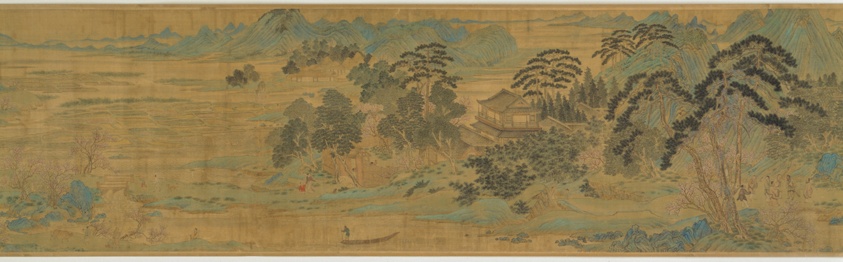
The Peach Blossom Spring 桃花源圖
Artist unknown (17th century), spurious signature of Qiu Ying 仇英 (c. 1500-1552)LinkedCulture matchlcp-720adf61c688
- Date
- Late Ming (1368–1644) or early Qing (1644–1912) dynasty
- Medium
- Handscroll; ink and color on silk
- Culture
- China
- Department
- Arts of Asia
- Institution
- Art Institute of Chicago
- Object ID
- 75361
From the Art Institute of Chicago record
This painting illustrates a fable written by Tao Qian (365-427). From right to left, the scroll depicts a fisherman’s accidental discovery of a peaceful and bountiful farming valley, which is isolated within a mountain cave. The valley’s inhabitants, who had fled from political turmoil six centuries earlier, are unaware of subsequent events in the outside world. Blossoming peach trees, symbolic of immortality, conceal the entrance to their secluded paradise. In depicting this mythic tale, many artists utilized a traditional palette of finely ground mineral pigments-azurite blue and malachite green- to evoke this jewel-like land. Qiu Ying was a renowned master of this “blue-and-green technique. While consistent with Qiu Ying’s precise and decorative style, the soft and restrained brushwork of this scroll suggests that it was painted by one of his close followers.
The authoritative record is held by Art Institute of Chicago. LinkedCulture surfaces this object and its connections; it does not alter institutional metadata.
Get printable QR codesHide QR codes
Open QR codes for this object page and the museum record. They stay collapsed until needed.
Provenance & credit
As published by the source institution. Coverage varies — not every institution's open-data feed includes ownership history.
- Credit line
- Kate S. Buckingham Endowment
Linked open data
Authority identifiers that link this record into the wider web of cultural data — stable references you can follow to the source.
- Object type
- AAT300033618
Related across collections
Semantically similar works from Art Institute of Chicago and other institutions.