Art Institute of Chicago
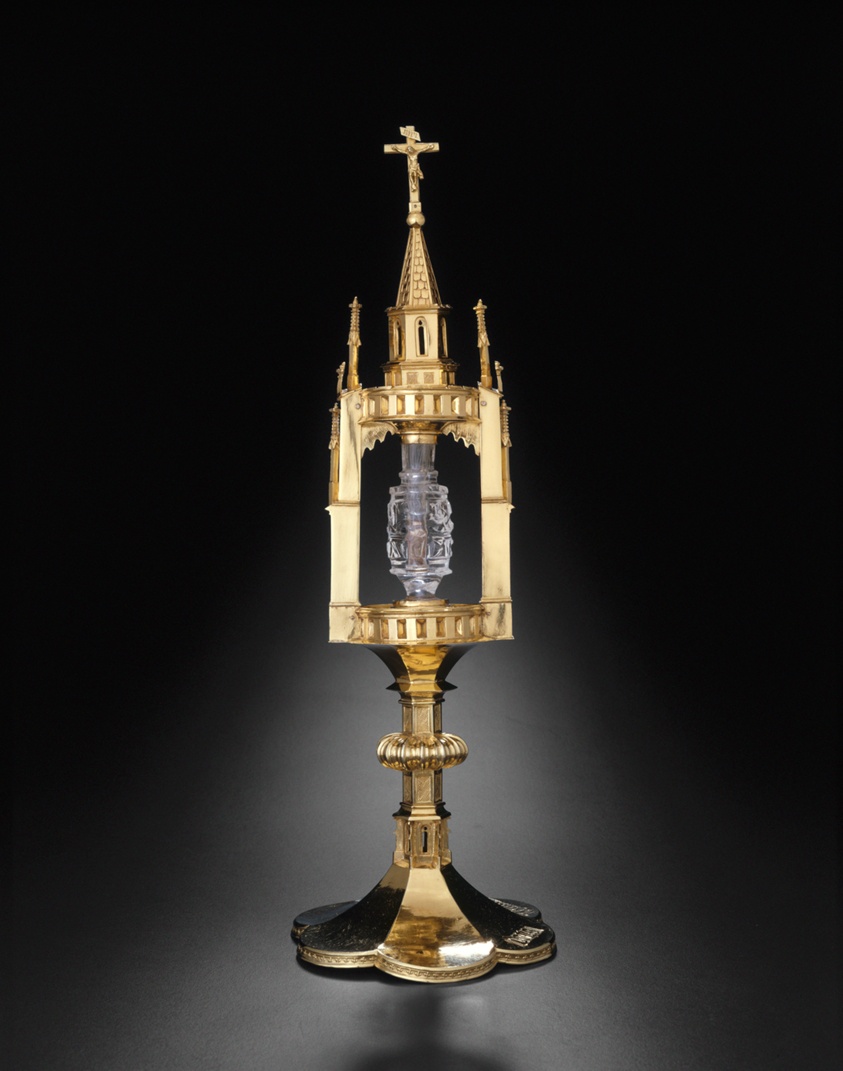
Reliquary Monstrance with a Tooth of Saint John the Baptist
Weddeghe Velstede (German, active 1432-73)LinkedCulture matchlcp-5d901eab98ed
- Date
- 1433; container: 900/1200
- Medium
- Silver gilt, rock crystal, textile, and human remains
- Culture
- Germany
- Department
- Applied Arts of Europe
- Institution
- Art Institute of Chicago
- Object ID
- 88419
From the Art Institute of Chicago record
This reliquary uses the form of a miniature Gothic tower. It makes an elaborate architectural frame for a transparent rock-crystal vessel holding a relic that is identified as a tooth of Saint John the Baptist by an inscription along the base of the reliquary. Rock crystal was highly prized in the medieval Islamic world. Considered a precious stone, it was used to create a number of luxurious secular objects, including this vessel, which was probably originally intended to be a container for fragrant oils.
The authoritative record is held by Art Institute of Chicago. LinkedCulture surfaces this object and its connections; it does not alter institutional metadata.
Get printable QR codesHide QR codes
Open QR codes for this object page and the museum record. They stay collapsed until needed.
Provenance & credit
As published by the source institution. Coverage varies — not every institution's open-data feed includes ownership history.
- Credit line
- Gift of Mrs. Chauncey McCormick
- Provenance
- The collegiate church of Saint Blaise, Braunschweig [no. 78 in the 1482 inventory of the relic treasure; see Boockmann 1997, pp. 33-34, 143 identifying it with the monstrance made for Saint Blasius by Wedegho Velstede in 1433], remaining there along with other treasure objects after the congregation abolished the Catholic service in 1540; Saint Blaise being under the direct patronage of the dukes of Braunschweig-Lüneburg, 1962.91 was given, together with the bulk of the church’s relic treasure to Duke Johann Friedrich (died 1679) in 1671 as part of a settlement among members of the ducal family [see Jaitner 1986 [1987], pp. 391-92]; by descent in the Hannover branch of the ducal family of Braunschweig-Lüneburg and preserved with the rest of the treasure in the court chapel of the Leineschloss, Hannover; temporarily removed for safe-keeping during the Seven Years War ( from 1757-64) and the Napoleonic Wars (removed 1803-1816) [Jaitner 1986 [1987], p. 393]; in 1862 installed in the Welfenmuseum in the Altenburg-Palais, Hannover, founded by King George V of Hannover (died 1878) [Hannover became a kingdom at the Congress of Vienna 1814/15; for the foundation of the museum, whose name evoked the medieval glory of the Welf or Guelph dynasty, see Jaitner 1986 [1987], pp. 393-98 and de Winter 1985, p. 13]; in 1867, following the annexation of the kingdom of Hannover by Prussia, moved with the bulk of the treasure to the exiled former king’s villa in Hietzing near Vienna; deposited at the Österreichisches Museum für Kunst und Industrie, Vienna, 1869 to 1906 [Jaitner 1986 [1987], pp. 402, 420 n. 59–the former king was styled duke of Cumberland];1906 sent to the duke of Cumberland’s palace in Penzing on the outskirts of Vienna and in 1920 to Schloss Cumberland in Gmunden, Austria [Jaitner 1986 [1987], p. 404]; in November 1927, the treasure was deposited with a bank in Aarau, Switzerland; at the end of 1929 under Ernst August III as head of the house of Hannover, the treasure was sold to a consortium of Frankfurt dealers: Julius Falk Goldschmidt of the firm I. S. Goldscmidt, Zacharias Max Hackenbroch, and Isaak Rosenbaum and Saemy Rosenbaum of the firm J. Rosenbaum [see De Winter 1985, p. 133; Jaitner 1986 (1987), p. 415 gives January 6, 1930 as the conclusion of the transaction]; they sold 1962.91 to Mrs. Chauncey McCormick, née Marion Deering, in January, 1931; on loan to the museum from 1931 [receipt R. 4806 of April 24, 1931 in Registrar’s office]; given to the museum in 1962.
Linked open data
Authority identifiers that link this record into the wider web of cultural data — stable references you can follow to the source.
- Object type
- AAT300411548
Related across collections
Semantically similar works from Art Institute of Chicago and other institutions.