Cleveland Museum of Art
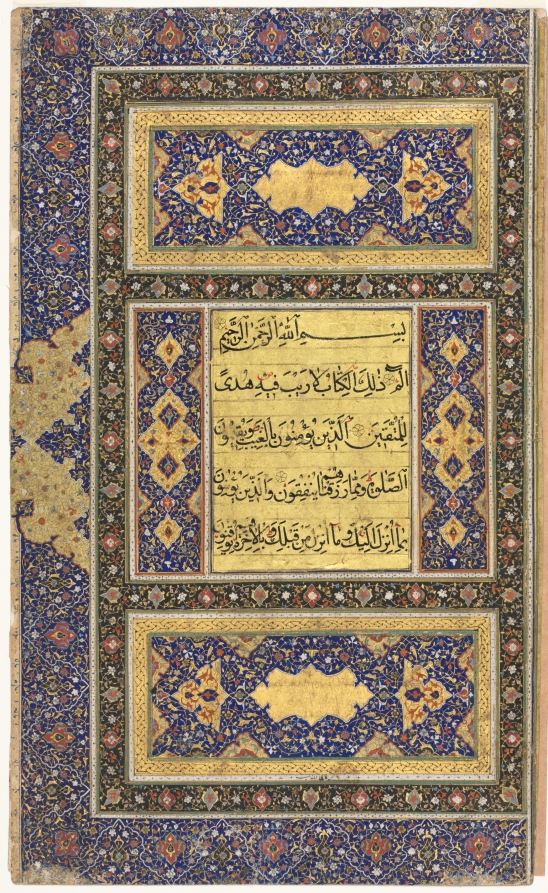
Qur'an Manuscript Folio (Recto); Left Folio of Double-Page Illuminated Frontispiece
- Date
- 1500s
- Medium
- ink, gold, and colors on paper
- Culture
- Afghanistan, Herat, Safavid period (1501–1722)
- Department
- Islamic Art
- Institution
- Cleveland Museum of Art
- Object ID
- 106707
From the Cleveland Museum of Art record
The Qur'an is the sacred book of Islam. In the view of orthodox Muslims, it is the literal word of God as revealed to the Prophet Muhammad (d. 632) in the Arabic language, and thus, recorded in the Arabic script. Because of its association with the divine word, Arabic calligraphy came to be a supreme art form in the Islamic world. As the quintessential symbol of the culture, it became a pervasive decorative element in Islamic art and architecture. Although secondary to calligraphy, a tradition of illumination—that is, ornamentation with colors and gold—developed to enhance the pages of the Qur'an. Because of the prestige associated with the book arts in the Islamic world, the decorative motifs employed by illuminators (scrolling vines, blossoms, lozenges, and cartouches) found their way into other art forms, for example, metalwork, textiles, and carpets.
The authoritative record is held by Cleveland Museum of Art. LinkedCulture surfaces this object and its connections; it does not alter institutional metadata.
Get printable QR codesHide QR codes
Open QR codes for this object page and the museum record. They stay collapsed until needed.
Provenance & credit
As published by the source institution. Coverage varies — not every institution's open-data feed includes ownership history.
- Credit line
- Purchase from the J. H. Wade Fund
- Provenance
- ?-1924: (Hagop Kevorkian [1872–1962], New York, NY, sold to the Cleveland Museum of Art) | 1924-: The Cleveland Museum of Art, Cleveland, OH
Related across collections
Semantically similar works from Cleveland Museum of Art and other institutions.