Cleveland Museum of Art
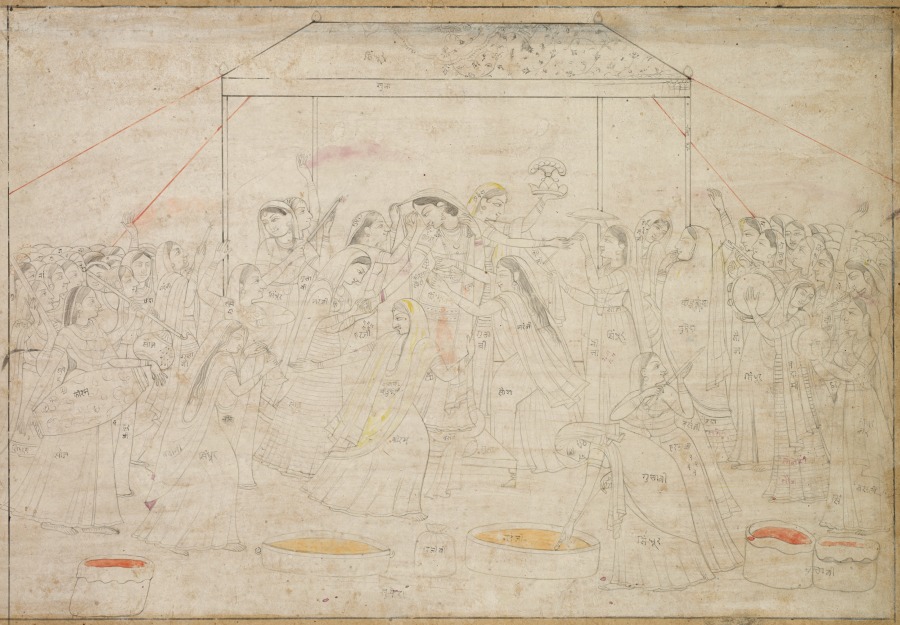
Krishna being dressed in women’s clothes for the spring festival Holi
- Date
- c. 1790
- Medium
- Ink and gum tempera on paper
- Culture
- Northern India, Pahari kingdoms
- Department
- Indian and Southeast Asian Art
- Institution
- Cleveland Museum of Art
- Object ID
- 114209
From the Cleveland Museum of Art record
The festival of Holi, which celebrates the arrival of spring, is a time of play when transgressing boundaries is allowed as part of the reckless joy and abandon of the day. Vats of colored water and powder in the foreground are used to fill handheld pumps to shoot colors at one another. The young women of the cowherd village where Krishna grew up gather around, fill their pumps, begin to play music, and cheekily dress Krishna as one of them. Radha, his favorite, holds his crown up high as she takes it away. He indulges them, just as he indulged all his devotees by taking on a human form. This unfinished work reveals the process of creating an Indian painting. The drawing was probably made by the master of the atelier who would have added the color notations, then given it to a colorist to paint. Another artist might have finished the faces and another the gold details before the work came back to the master for its finishing touches and final approval. A few preliminary patches of color in the foreground indicate the palette intended to be applied to the entire painting.
The authoritative record is held by Cleveland Museum of Art. LinkedCulture surfaces this object and its connections; it does not alter institutional metadata.
Get printable QR codesHide QR codes
Open QR codes for this object page and the museum record. They stay collapsed until needed.
Provenance & credit
As published by the source institution. Coverage varies — not every institution's open-data feed includes ownership history.
- Credit line
- Edward L. Whittemore Fund
- Provenance
- ?–1933: Ananda K. Coomaraswamy [1877–1947], Boston, MA, sold to the Cleveland Museum of Art | 1933–: The Cleveland Museum of Art, Cleveland, OH
Related across collections
Semantically similar works from Cleveland Museum of Art and other institutions.