Cleveland Museum of Art
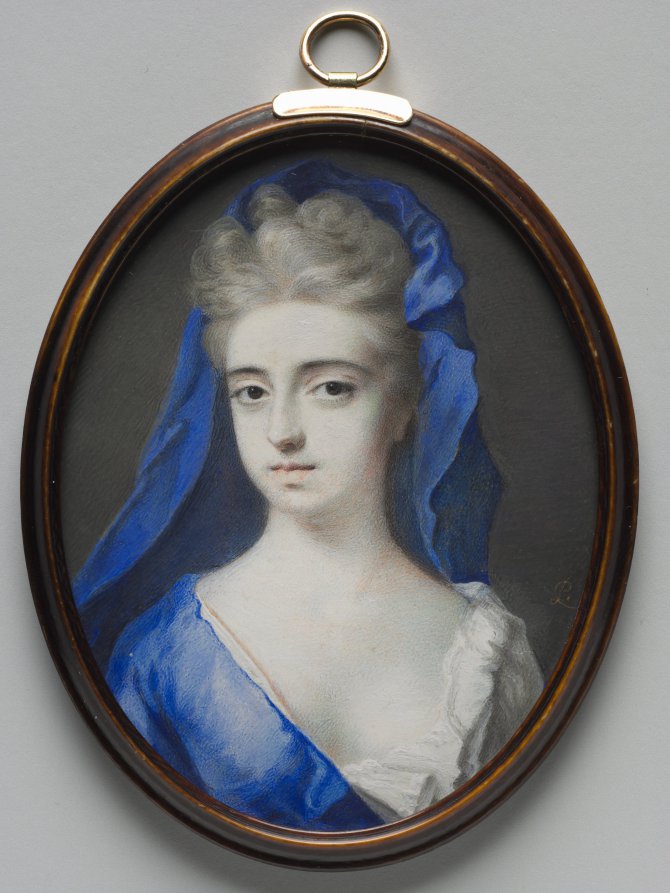
Portrait of a Woman in Blue
Peter CrossLinkedCulture matchlcp-3a9286e1fc5c
- Date
- c. 1700
- Medium
- watercolor on vellum in original ivory frame
- Culture
- England, early 18th Century
- Department
- European Painting and Sculpture
- Institution
- Cleveland Museum of Art
- Object ID
- 120829
From the Cleveland Museum of Art record
Living in London, the youngest of seven children, Peter Cross was probably apprenticed to a limner following the death of his wealthy father. His first miniatures date from around 1661, and he remained active until his death, ushering the medium into the eighteenth century; the greatest British miniaturists working during his lifetime, all had died or ceased to work by 1700. Although ivory had been adopted as a support for British miniature painting a decade before his death, Cross exclusively used the older medium of vellum adhered to card. The artist was also an avid collector, assembling an impressive group of miniatures that included at least twelve works by his neighbor Samuel Cooper. This collection was sold in 1722 at Cross’s house in Covent Garden. Cross’s style is distinguished by a fi ne stippling of colors that combine to create soft, voluminous hair and pale flesh tones. His later works tend to leave the prepared white ground of the vellum bare—coincidentally, a strategy that was adopted by artists painting miniatures on ivory to exploit the support’s translucence. The details of his early instruction are still obscure, but some scholars have postulated that Cooper trained Cross, whereas others note a greater resemblance to the style of Hoskins, and still others detect a similarity to French stippling and suggest that he may have been trained overseas. The artist depicted the unknown sitter almost full face before a plain gray background with her head turned slightly to the right. She dons a white gown trimmed with ruffles at the neckline and a bright blue mantle over her right shoulder. Her powdered hair is swept up and loosely covered either by the blue mantle or a scarf of the same color. This miniature is in its original ivory frame, stained a mottled brown to imitate tortoise shell.
The authoritative record is held by Cleveland Museum of Art. LinkedCulture surfaces this object and its connections; it does not alter institutional metadata.
Get printable QR codesHide QR codes
Open QR codes for this object page and the museum record. They stay collapsed until needed.
Provenance & credit
As published by the source institution. Coverage varies — not every institution's open-data feed includes ownership history.
- Credit line
- The Edward B. Greene Collection
- Provenance
- By 1875: Possibly Anthony Ashley-Cooper, 7th Early of Shaftesbury (1801-1885), Wimborne St. Giles, Dorset, England | By 1889-1901: Sir Francis Cook, 1st Baronet (1817-1901), Richmond, England and Sintra, Portugal, by inheritance to his son, Wyndham Francis Cook | 1901-1905: Wyndham Francis Cook (1860-1905), London, England, by inheritance to his wife Frederica Evelyn Stillwell Cook | 1905-1925: Frederica Evelyn Stillwell Cook (née Freeland, died 1925), London, England, by inheritance to her son, Humphrey Wyndam Cook | 1925: Humphrey Wyndham Cook (1893–1978), London, England | July 9, 1925: (Sale: Christie's London, July 9, 1925, lot 319) | 1925-1928: (Leo Schidhof (1886-1966), Paris, France, sold to Edward B. Greene) | 1928-1941: Edward B. Greene (1878-1957), Cleveland, OH, gifted to the Cleveland Museum of Art | 1941-: The Cleveland Museum of Art, Cleveland, OH
Part of a LinkedCulture topic
 English Portrait Miniatures
A collection of portrait miniatures from 17th-18th century England, predominantly featuring watercolor on ivory or graphite and wash techniques, representing the tradition of intimate personal portraiture in miniature fo
221 objects from 4 institutions
Related across collections
Semantically similar works from Cleveland Museum of Art and other institutions.