Cleveland Museum of Art
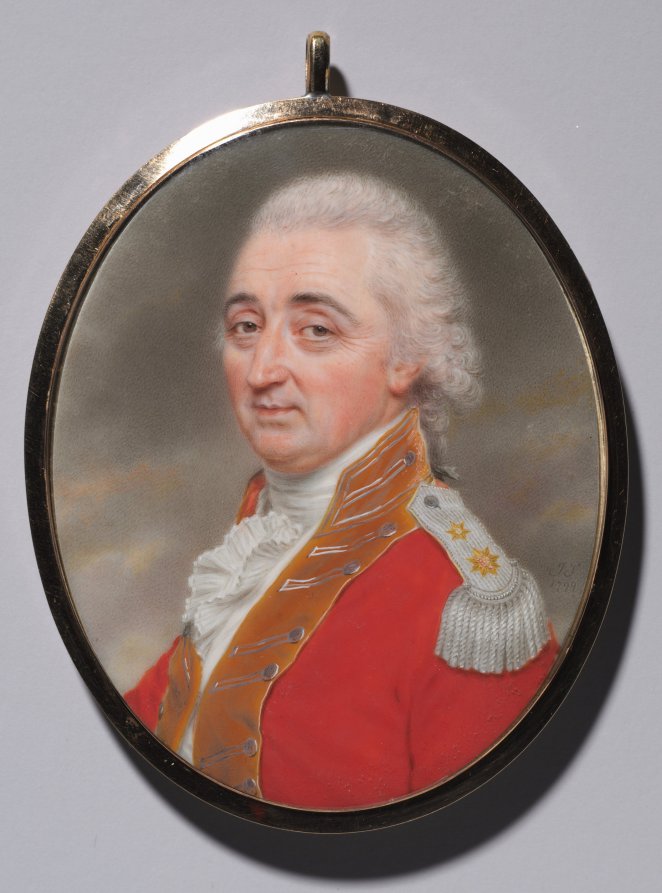
Portrait of Lieutenant General Daniel Burr
John I SmartLinkedCulture matchlcp-678a8aa663ce
- Date
- 1799
- Medium
- watercolor on ivory in a gold frame with glazed hair reverse
- Culture
- England, 18th century
- Department
- European Painting and Sculpture
- Institution
- Cleveland Museum of Art
- Object ID
- 121286
From the Cleveland Museum of Art record
Daniel Burr (1750–1828) is depicted here as colonel of the 10th Madras Native Infantry. He joined the East India Company in 1767 as a cadet, became an ensign in 1768, a colonel in 1797, and achieved the rank of major general in 1805. The work is signed and dated “JS / 1799,” indicating that John Smart painted Burr while the officer was back in England on furlough between July 30, 1798, and April 2, 1799. Diarist Joseph Farington noted in 1798 that Smart was charging 25 guineas for his portrait miniatures and making from £500 to £600 a year. By comparison, George Engleheart (1752–1829) during this period was charging 12 to 15 guineas for his portrait miniatures, and even in the 1780s, Richard Cosway (1742–1821) was known to charge between 20 and 30 guineas. This work was exhibited at the Royal Academy in 1799 (no. 784) as “Portrait of Colonel Burr.” It was formerly in the collection of Benjamin Nathan, a wealthy London goldsmith and diamond dealer whose heirs did not wish to retain the miniature and sold it upon his death. Here, Daniel Burr has a ruddy complexion, gray hair, and brown eyes. He wears a red military coat, with dull orange velvet facings, over a jabot with a high white collar and frills. On his left shoulder is a white, fringed epaulet with two gold stars. The background is mottled gray. The miniature is housed in a gold frame with a gold monogram DB and an arrangement of dark brown hair in a medallion on the back. At slightly over 3 inches, this miniature is larger than was customary for Smart during his time in India; it was obviously painted later, when Smart and the officer had returned to England. Smart also painted the miniature portrait of Burr’s first wife, Lucy (née Parry). A second portrait of Burr was executed by Smart in 1803 and sold at Christie’s, London, in 2009. This version is signed with initials and dated: “JS / 1803.” Burr’s hair is worn à l’antique , and his uniform includes a gold epaulet with two star rank badges and the Honourable East India Company’s coat of arms. Burr occupied the rank of colonel in both the 1799 and 1803 portraits, but the uniform differs in the latter because in 1801 the facings of the 10th Madras Native Infantry uniform were altered to red, and rank badges were added to the now gold epaulets. Curiously, Burr appears younger in the 1803 portrait than in the 1799 version, in which his crow’s feet and sagging jowls are more pronounced. The 1803 portrait of Burr was exhibited at the Royal Academy in 1811 (no. 637), the year Smart died. A sketch after Smart of Burr was executed by R. Greaves, and a three-quarter length portrait by Sir Martin Archer Shee was exhibited at the Royal Academy in 1825 (no. 146). The verso or back side contains gilt initials DB and an intricate pattern of braided hair.
The authoritative record is held by Cleveland Museum of Art. LinkedCulture surfaces this object and its connections; it does not alter institutional metadata.
Get printable QR codesHide QR codes
Open QR codes for this object page and the museum record. They stay collapsed until needed.
Provenance & credit
As published by the source institution. Coverage varies — not every institution's open-data feed includes ownership history.
- Credit line
- The Edward B. Greene Collection
- Provenance
- Before 1930: Benjamin Nathan, London, England | -1930: (Leo Schidlof, Paris, France, sold to Edward B. Greene) | 1930-1942: Edward B. Greene (1878-1957), Cleveland, OH, gifted to the Cleveland Museum of Art | 1942-: The Cleveland Museum of Art, Cleveland, OH
Part of a LinkedCulture topic
 English Portrait Miniatures
A collection of portrait miniatures from 17th-18th century England, predominantly featuring watercolor on ivory or graphite and wash techniques, representing the tradition of intimate personal portraiture in miniature fo
221 objects from 4 institutions
Related across collections
Semantically similar works from Cleveland Museum of Art and other institutions.