Cleveland Museum of Art
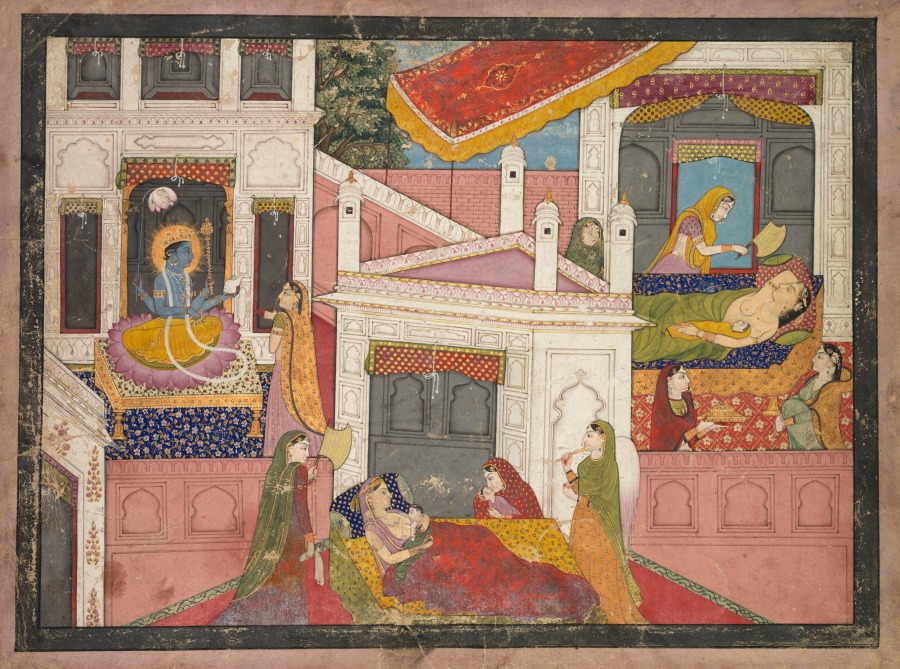
The birth of Rama and his brothers, from Chapter 17 of the Bala Kanda (Book of Childhood) of the Adhyatma Ramayana (Rama's Journey of the Supreme Spirit) from the Brahmanda Purana (Ancient Scripture of the Cosmic Egg)
- Date
- c. 1820–30
- Medium
- Gum tempera, ink, and gold on paper
- Culture
- Northern India, Pahari Region, Himachal Pradesh, Rajput Kingdom of Kangra, Court of Aniruddh Chand (reigned 1823–33)
- Department
- Indian and Southeast Asian Art
- Institution
- Cleveland Museum of Art
- Object ID
- 130365
From the Cleveland Museum of Art record
In a retelling of the Ramayana from the 1200s, the blue god Vishnu appears in a vision to Queen Kaushalya just before she gives birth to his incarnation as Rama. In the foreground, her co-wife Queen Sumitra nurses one of her own newborn twins, Lakshmana and Shatrughna. Rama’s half-brother Bharata lies swaddled next to his mother Queen Kaikeyi on an adjacent terrace of the women’s quarters. The patterned carvings and textiles of the palace interior communicate the luxury into which the princes were born, and from which Rama and Lakshmana will be eventually exiled. King Dasharatha thought his wife Kaikeyi, shown sleeping, was the most beautiful of his three wives.
The authoritative record is held by Cleveland Museum of Art. LinkedCulture surfaces this object and its connections; it does not alter institutional metadata.
Get printable QR codesHide QR codes
Open QR codes for this object page and the museum record. They stay collapsed until needed.
Provenance & credit
As published by the source institution. Coverage varies — not every institution's open-data feed includes ownership history.
- Credit line
- Edward L. Whittemore Fund
- Provenance
- ?–1953: (Heeramaneck Galleries, New York, NY, sold to the Cleveland Museum of Art) | 1953–: The Cleveland Museum of Art, Cleveland, OH
Related across collections
Semantically similar works from Cleveland Museum of Art and other institutions.