Cleveland Museum of Art
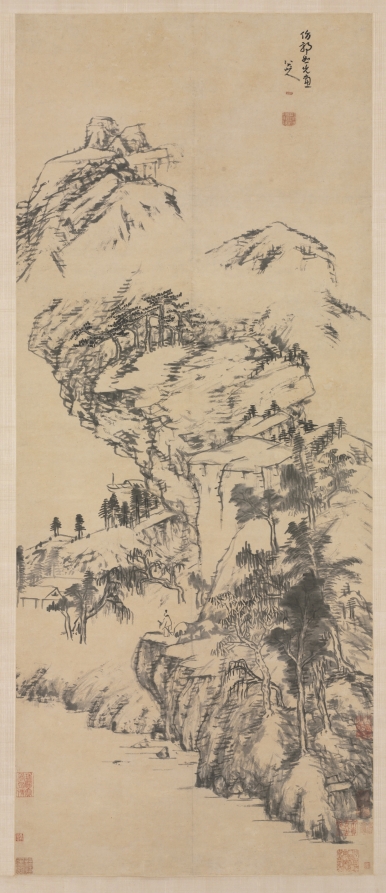
Landscape after Guo Zhongshu
Bada ShanrenLinkedCulture matchlcp-3e5120a0487f
- Date
- c. 1680–1705
- Medium
- Hanging scroll; ink on paper
- Culture
- China, Qing dynasty (1644-1911)
- Department
- Chinese Art
- Institution
- Cleveland Museum of Art
- Object ID
- 132908
From the Cleveland Museum of Art record
Similar to some calligraphers of his time, Zhu Da rejected conventions in favor of an individual, personal expression. He is known for ambiguous compositions of fish, flowers, birds, and rocks in contrasting ink tonality. As a member of the Ming imperial family, Zhu lost his princely status and hid in a monastery when the Manchus, foreigners from the north, established the Qing dynasty in 1644. In this late work, mountain ranges are rendered in diverse and dense strokes rising toward the top of the scroll. It references the artist Dong Qichang (1555–1636) in concept. Yet the cursory brushwork and composition present Zhu’s personal style. Zhu Da's inscription acknowledges that this painting was done after the early Song master Guo Zhongshu 郭忠恕, but there is almost no tangible stylistic relation to be found between Zhu Da and his 10th-century model.
The authoritative record is held by Cleveland Museum of Art. LinkedCulture surfaces this object and its connections; it does not alter institutional metadata.
Get printable QR codesHide QR codes
Open QR codes for this object page and the museum record. They stay collapsed until needed.
Provenance & credit
As published by the source institution. Coverage varies — not every institution's open-data feed includes ownership history.
- Credit line
- John L. Severance Fund
- Provenance
- Chang Dai-chien [Zhang Daqian 張大千] [1899–1983] | ?–1955: (Walter Hochstadter [1914–2007], New York, NY, sold to the Cleveland Museum of Art) | 1955–: The Cleveland Museum of Art, Cleveland, OH
Part of a LinkedCulture topic
 Chinese landscape paintings
These are predominantly Chinese paintings from the Ming, Qing, Yuan, and Song dynasties that depict natural landscape scenes including mountains, rivers, forests, and human settlements using traditional media such as ink
180 objects from 5 institutions
Related across collections
Semantically similar works from Cleveland Museum of Art and other institutions.