Cleveland Museum of Art
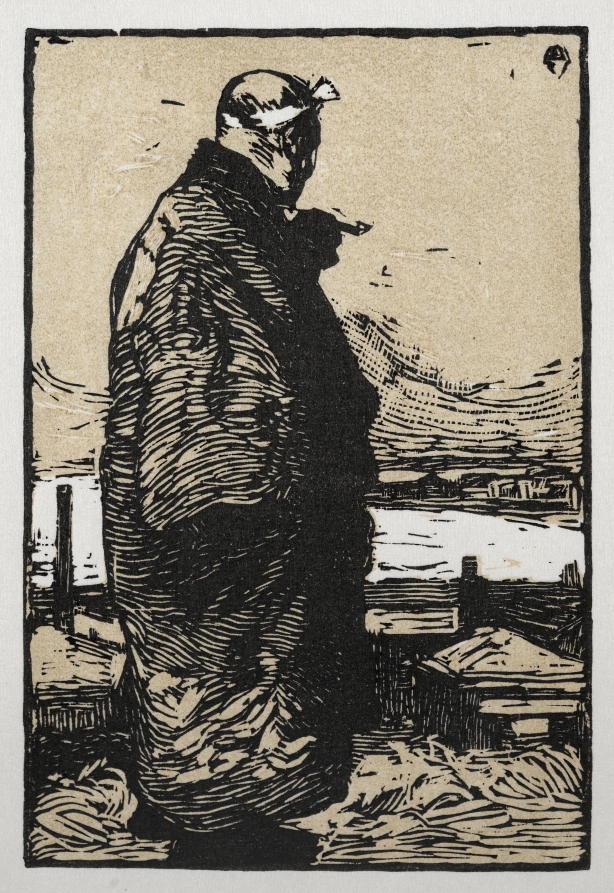
Fisherman
Yamamoto KanaeLinkedCulture matchlcp-00aa7411324e
- Date
- 1906
- Medium
- woodcut
- Culture
- Japan, Meiji period (1868–1912)
- Department
- Japanese Art
- Institution
- Cleveland Museum of Art
- Object ID
- 136225
From the Cleveland Museum of Art record
This modest print marks the beginning of the sosaku-hanga movement which encouraged artists to carve and print woodblocks themselves. Fisherman , featured in the art and literary magazine Myojo (Morning Star) in 1904, accompanied an article describing Yamamoto’s revolutionary defiance of the traditional separation between the originator of the design and the artisans who execute the print, elevating woodcuts to the level of fine art. The print is also unmistakably modern in the simple, poignant depiction of the old man of the sea and in the artist’s deliberate retention of traces left by the gouge that cut the block. From the mid-19th century, when European and American artists first discovered ukiyo-e prints, Japanese pictorial conventions had a major influence on Western art. In the same way, when American naval officer Matthew Perry arrived in Japan in 1853, ending the island’s 200 years of seclusion, Japanese artists began to emulate aspects of European art. Yamamoto was impacted by British printmaker William Nicholson, who in turn had derived his bold style of a flat figure against an unmodulated background from Japanese woodcuts.
The authoritative record is held by Cleveland Museum of Art. LinkedCulture surfaces this object and its connections; it does not alter institutional metadata.
Get printable QR codesHide QR codes
Open QR codes for this object page and the museum record. They stay collapsed until needed.
Provenance & credit
As published by the source institution. Coverage varies — not every institution's open-data feed includes ownership history.
- Credit line
- Anonymous gift in memory of Paul O. Cartun
Related across collections
Semantically similar works from Cleveland Museum of Art and other institutions.