Cleveland Museum of Art
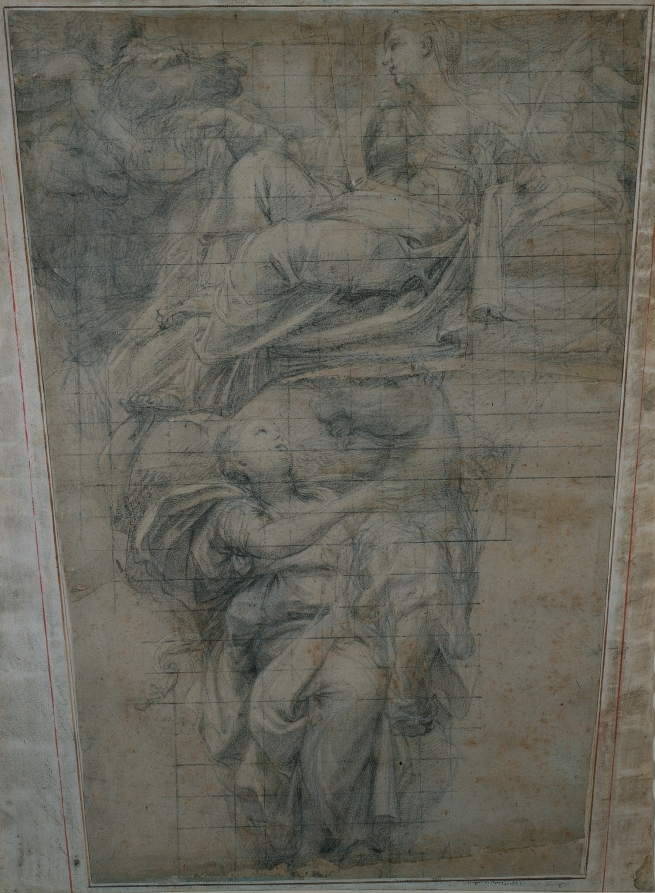
Temperance
DomenichinoLinkedCulture matchlcp-5fe82e9438cf
- Date
- 1628–30
- Medium
- black chalk heightened with white chalk, squared with black chalk
- Culture
- Italy, 17th century
- Department
- Drawings
- Institution
- Cleveland Museum of Art
- Object ID
- 141207
From the Cleveland Museum of Art record
The gridded pattern superimposed over the figures in this scene indicates that this drawing was used a preparatory study for one of Domenichino’s frescoes depicting the four cardinal virtues inside the dome of the Church of San Carlo ai Catinari in Rome. This technique—called squaring—was a common method used in seventeenth-century Italy to transfer a design from one surface to another. Domenichino prepared the design on three separate sheets of paper, all with irregular edges cut and pasted onto a larger sheet. At the top, the allegorical figure of Temperance, one of four cardinal virtues, reclines gracefully on a cloud. She holds a palm branch in her left hand and extends her right out toward a hovering putto in the upper left corner. The changes made to Temperance’s right hand and the presence of two camel heads (only one appears in the finished fresco) reveal the artist’s process for working out the poses and placements of the figures in his composition. Despite having carefully prepared the composition for his fresco of Temperance with this and other drawings, Domenichino left Rome before completing the painting. It was later finished by one of his pupils.
The authoritative record is held by Cleveland Museum of Art. LinkedCulture surfaces this object and its connections; it does not alter institutional metadata.
Get printable QR codesHide QR codes
Open QR codes for this object page and the museum record. They stay collapsed until needed.
Provenance & credit
As published by the source institution. Coverage varies — not every institution's open-data feed includes ownership history.
- Credit line
- Dudley P. Allen Fund
- Provenance
- ?-?: Lord Barrymore | ?-1964: Prof. J. Isaacs. His sale, Sotheby’s, London, 27 February, 1964, no. 24 (as 17th century Italian School) | 1964-1965: with Gemma Donati, London and Rome | 1964-: The Cleveland Museum of Art, Cleveland, OH
Related across collections
Semantically similar works from Cleveland Museum of Art and other institutions.