Cleveland Museum of Art
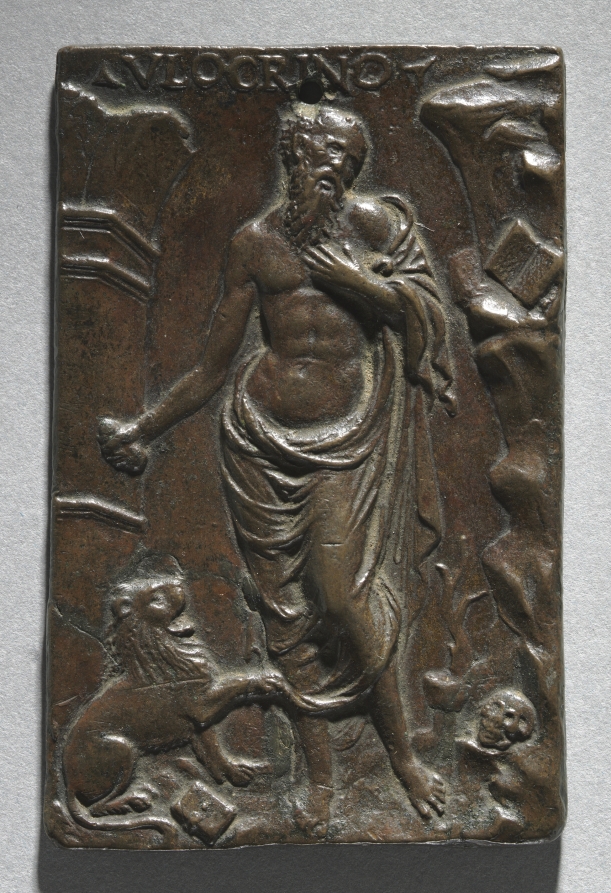
Saint Jerome
UlocrinoLinkedCulture matchlcp-b939e5991512
- Date
- 1500s
- Medium
- bronze
- Culture
- Italy, Padua?, 16th century
- Department
- European Painting and Sculpture
- Institution
- Cleveland Museum of Art
- Object ID
- 144308
From the Cleveland Museum of Art record
During the Renaissance, humanist scholars sought to revive not only the Greek and Roman past, but also the early Christian era. Among the most fully studied figures of Christian antiquity was Saint Jerome, whose letters were widely read and vividly describe his physical and spiritual trials in the Syrian desert. Here Jerome appears in such a setting between a broken classical arch and rocky cliff, on the ledges of which are an open book and skull. In his extended right hand he holds a stone that he used to beat his breast while living as an ascetic. In the lower left corner a lion, the legendary companion of the saint, sits beside a closed book. The inscribed signature Ulocrino appears on a number of plaquettes in the early 1500s that stylistically relate to the work of Paduan sculptors from this period. Attempts to identify this artist have prompted a number of proposals: the most intriguing suggests that "Ulocrino" is a pseudonym made from the Greek oulos and the Latin crinis , meaning curly-haired, for Andrea Briosco, better known by the nickname Riccio on account of his wavy hair. Riccio was one of the most renowned Paduan bronze sculptors of the 1500s.
The authoritative record is held by Cleveland Museum of Art. LinkedCulture surfaces this object and its connections; it does not alter institutional metadata.
Get printable QR codesHide QR codes
Open QR codes for this object page and the museum record. They stay collapsed until needed.
Provenance & credit
As published by the source institution. Coverage varies — not every institution's open-data feed includes ownership history.
- Credit line
- Gift of Mrs. Chester D. Tripp
- Provenance
- Jacob Hirsch, 1874-1955 (New York, New York) | (Bank Leu, Zurich), sold to the Cleveland Museum of Art, 1969.
Related across collections
Semantically similar works from Cleveland Museum of Art and other institutions.