Cleveland Museum of Art
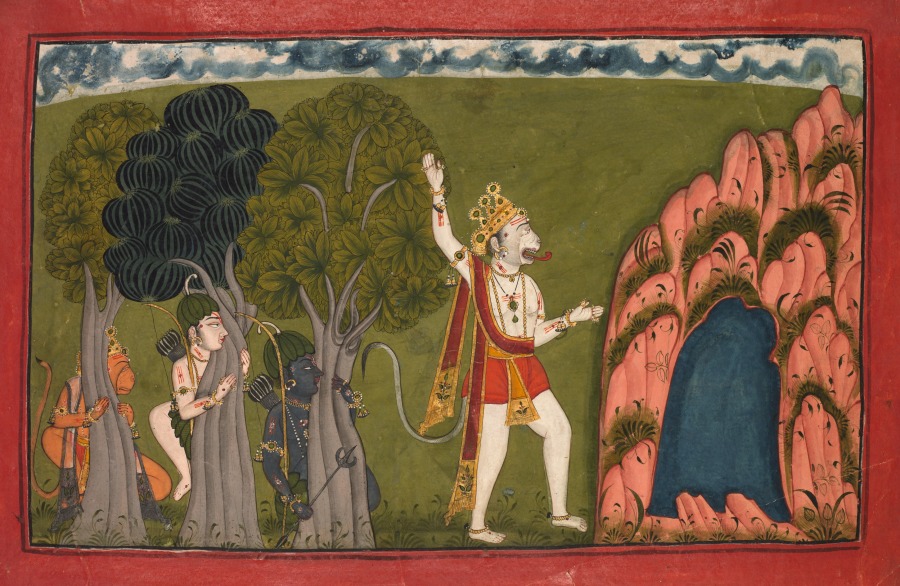
Sugriva challenges his brother Vali, King of the Forest Dwellers, to a duel, folio 10 from the Kishkindha Kanda (Book of Kishkindha) of a Ramayana (Rama’s Journey)
- Date
- c. 1700–1720
- Medium
- Gum tempera, ink, and gold on paper
- Culture
- Northern India, Pahari kingdoms
- Department
- Indian and Southeast Asian Art
- Institution
- Cleveland Museum of Art
- Object ID
- 147129
From the Cleveland Museum of Art record
In a morally ambiguous scene, the white monkey Sugriva calls to his brother Vali, the rightful king of the forest-dwellers, to emerge from a cave. Behind him, the blue hero Rama hides with his brother and monkey ally Hanuman. Clutching a deadly three-pronged arrow, Rama prepares to slay Vali, so Sugriva will rise as king and be obliged to help locate Rama’s lost wife. Paintings from this series illustrate a local Himalayan Ramayana . Their distinctive style incorporates rock formations and textiles reinterpreted from Mughal sources, probably brought to Nurpur when the Mughal emperor retreated there during the hot season. The orange monkey Hanuman and the princes Lakshmana and Rama hide behind trees while Sugriva calls for Vali.
The authoritative record is held by Cleveland Museum of Art. LinkedCulture surfaces this object and its connections; it does not alter institutional metadata.
Get printable QR codesHide QR codes
Open QR codes for this object page and the museum record. They stay collapsed until needed.
Provenance & credit
As published by the source institution. Coverage varies — not every institution's open-data feed includes ownership history.
- Credit line
- Purchase from the J. H. Wade Fund
- Provenance
- ?–1973: (William H. Wolff, Inc., New York, NY, sold to the Cleveland Museum of Art) | 1973–: The Cleveland Museum of Art, Cleveland, OH
Related across collections
Semantically similar works from Cleveland Museum of Art and other institutions.