Cleveland Museum of Art
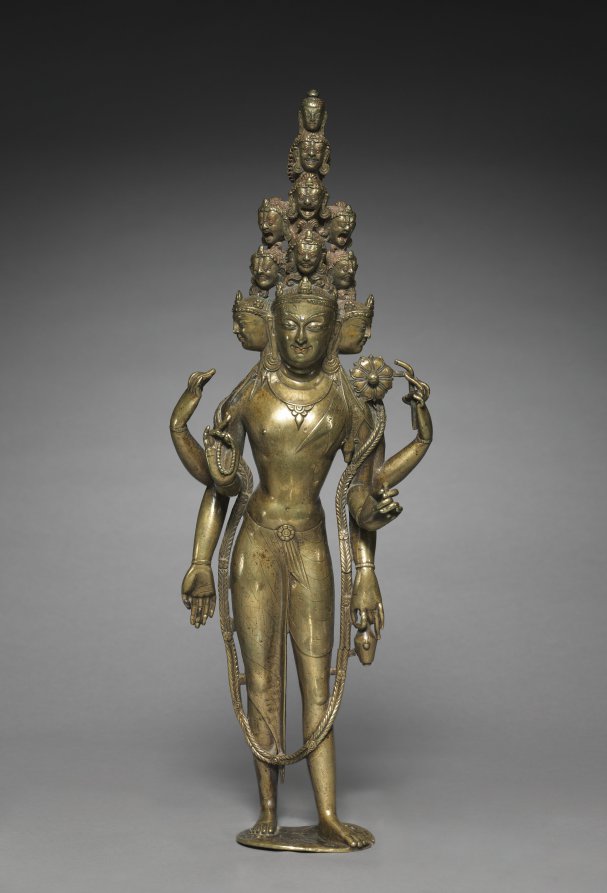
Eleven-Headed Bodhisattva of Compassion (Avalokiteshvara)
- Date
- around 1000
- Medium
- gilt bronze with silver and copper inlay
- Culture
- Western Himalayas
- Department
- Indian and Southeast Asian Art
- Institution
- Cleveland Museum of Art
- Object ID
- 148021
From the Cleveland Museum of Art record
One of the finest surviving examples of its kind, this rare six-armed form of Avalokiteshvara has the slender athletic figure and penetrating expression associated with the art of Kashmir, the main source for western Tibetan styles. This Bodhisattva combines the qualities of a prince and an ascetic, with his crown and jewels combined with the yogi's antelope skin over his left shoulder and prayer beads in his middle right hand. Representing the range of Avalokiteshvara's forms and aspects, his eleven heads are remarkably articulated with individualized features. They follow textual descriptions that describe his three placid faces, three fierce faces, three terrifying howling faces, and one laughing face, all surmounted by a head of the Buddha Amitabha, with whom he is closely associated. Tongues and lips have been inlaid with copper to extraordinary effect, and a miniature seated figure of Amitabha Buddha has been placed in the center of every crown. The bottle in his lower-left hand contains the nectar of immortality.
The authoritative record is held by Cleveland Museum of Art. LinkedCulture surfaces this object and its connections; it does not alter institutional metadata.
Get printable QR codesHide QR codes
Open QR codes for this object page and the museum record. They stay collapsed until needed.
Provenance & credit
As published by the source institution. Coverage varies — not every institution's open-data feed includes ownership history.
- Credit line
- Andrew R. and Martha Holden Jennings Fund
- Provenance
- ?–1975: (J. E. Eskenazi, Ltd., London, England, sold to the Cleveland Museum of Art) | 1975–: The Cleveland Museum of Art, Cleveland, OH
Related across collections
Semantically similar works from Cleveland Museum of Art and other institutions.