Cleveland Museum of Art
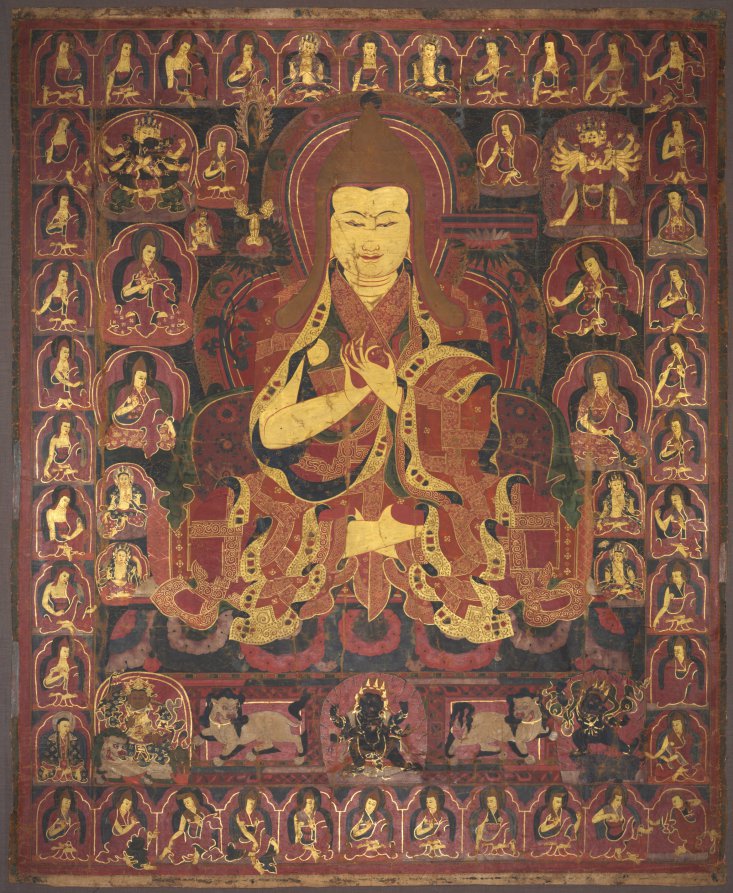
Tsong Khapa, Founder of the Geluk Order
- Date
- c. 1440–70
- Medium
- Gum tempera and gold on cotton
- Culture
- Central Tibet
- Department
- Indian and Southeast Asian Art
- Institution
- Cleveland Museum of Art
- Object ID
- 150468
From the Cleveland Museum of Art record
The Buddhist order to which the Dalai Lamas belong was founded by Tsong Khapa (1357–1419), whose image is seen here as the large central figure holding his hands in the teaching mudra. He wears the pointed golden hat that is the insignia for monks of the Geluk order. At the level of his ears are the sword and book, emblems of Manjushri, the bodhisattva of wisdom. These emblems allude to the Tibetan Buddhist tradition that accorded Tsong Khapa the status of being an emanation of Manjushri. This extraordinary, sumptuously rendered painting, made only decades after his death, retains elements of portraiture in the facial features that become formalized in later works, especially from the mid-1600s onward, when the Geluk monks dominated the Tibetan theocracy. He is surrounded by lineage masters, many in lively gestures of debate, whose analyses of doctrines and practices led to Tsong Khapa's final formulation of the Lam Rim text on the stages of the path to enlightenment, which is foundational to the Geluk order.
The authoritative record is held by Cleveland Museum of Art. LinkedCulture surfaces this object and its connections; it does not alter institutional metadata.
Get printable QR codesHide QR codes
Open QR codes for this object page and the museum record. They stay collapsed until needed.
Provenance & credit
As published by the source institution. Coverage varies — not every institution's open-data feed includes ownership history.
- Credit line
- Purchase from the J. H. Wade Fund
- Provenance
- ?–1981: (Ted Bieler Studios, Ontario, Canada, sold to the Cleveland Museum of Art) | 1981–: The Cleveland Museum of Art, Cleveland, OH
Related across collections
Semantically similar works from Cleveland Museum of Art and other institutions.