Cleveland Museum of Art
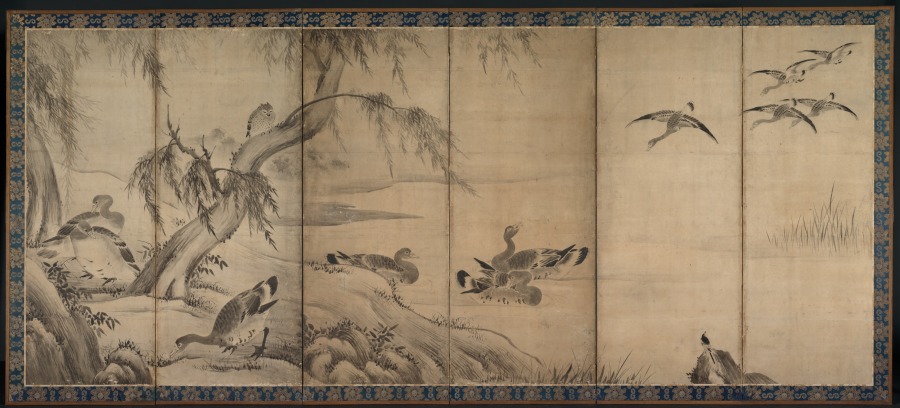
Wild Geese
Kano SanrakuLinkedCulture matchlcp-e25f64bcf537
- Date
- late 1500s-early 1600s
- Medium
- pair of six-fold screens; ink on paper
- Culture
- Japan, Edo period (1615–1868)
- Department
- Japanese Art
- Institution
- Cleveland Museum of Art
- Object ID
- 153798
From the Cleveland Museum of Art record
Depictions of geese usually appear as ink paintings in Japan during the 1200s. They later show up in the colorful landscapes of illustrated handscrolls. Such early ink renditions of the birds have long been associated with classical Chinese Zen painting and poetry, which was avidly admired and collected in medieval Japan. In the screens on display, the artist portrayed the waterfowl in a pastoral setting without reference to classical or religious themes. Such ordinary subjects were imbued with special meaning in 14th- and 15th-century Japan through associations with continental culture, Zen thought and poetry, and famous Chinese monk-painters whose painting techniques had become revered as visual emblems of Zen principles. The screens here reflect the continuation of that painting tradition in the late 1500s or early 1600s by the head of the most important studio in Kyoto. Sanraku also executed a number of colorful folding screen compositions, but here pays homage to the style of early Zen painting.
The authoritative record is held by Cleveland Museum of Art. LinkedCulture surfaces this object and its connections; it does not alter institutional metadata.
Get printable QR codesHide QR codes
Open QR codes for this object page and the museum record. They stay collapsed until needed.
Provenance & credit
As published by the source institution. Coverage varies — not every institution's open-data feed includes ownership history.
- Credit line
- Leonard C. Hanna Jr. Fund
- Provenance
- ?-1987: (Eastern Fine Arts, New York, NY, ?-1987. Sold to the Cleveland Museum of Art) | 1987-: The Cleveland Museum of Art, Cleveland, OH, 1987-present
Related across collections
Semantically similar works from Cleveland Museum of Art and other institutions.