Cleveland Museum of Art
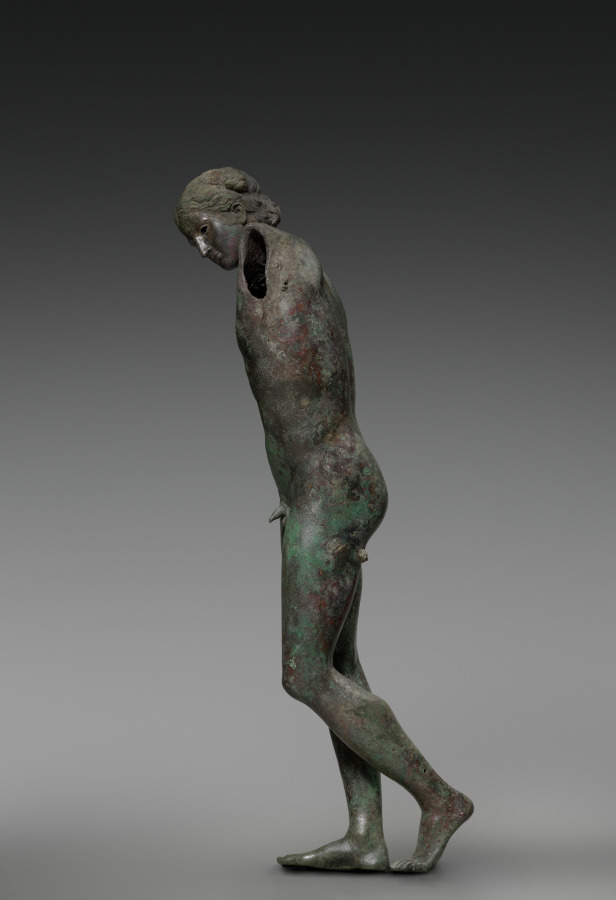
The Cleveland Apollo: Apollo Sauroktonos (Lizard-Slayer) or Apollo the Python-Slayer
PraxitelesLinkedCulture matchlcp-baedacf5c6ed
- Date
- c. 350–200 BCE
- Medium
- bronze, copper and stone inlay
- Culture
- Greece, Athens
- Department
- Greek and Roman Art
- Institution
- Cleveland Museum of Art
- Object ID
- 163449
From the Cleveland Museum of Art record
The Cleveland Apollo was cast in multiple sections using the indirect lost-wax technique. First, molds were taken from a working model (now no longer known or preserved), which was then reproduced in hollow wax sections, each filled with a clay core. After details were added to the wax models, each was encased in clay. Then, the wax was heated, melted out, and replaced by molten bronze. Once cooled, the hollow bronze sections were fused together and finished, patching flaws and adding inlays and other details. Since the initial model was retained, it could be reused, allowing ancient sculptors to create multiples and variations of favorite works. Thus, remarkably, the Cleveland Apollo may once have been one of several such works. The consistently thin walls of the Cleveland Apollo (mostly 5-6 mm thick), together with the nearly invisible joins between most cast sections, show that it was created by highly skilled sculptors and foundry workers. Close looking reveals several noteworthy features. First, ovals atop the right foot mark a fusion weld, where molten bronze pooled to join separately cast sections. Second, small rectangular bronze patches cover parts of the surface (especially the right hip), each carefully cut and then hammered into place over holes or other casting defects. Inlaid lips, nipples, and eyes (the right ancient stone, the left now a modern replacement) added to the lifelike appearance of the sculpture, contrasting with the once bronze-colored skin. Finally, radiography helps to illuminate hidden features, such as the cast edge of the neck of Apollo. Ovals across the top of the right foot show a clear join between separately cast sections.
The authoritative record is held by Cleveland Museum of Art. LinkedCulture surfaces this object and its connections; it does not alter institutional metadata.
Get printable QR codesHide QR codes
Open QR codes for this object page and the museum record. They stay collapsed until needed.
Provenance & credit
As published by the source institution. Coverage varies — not every institution's open-data feed includes ownership history.
- Credit line
- Severance and Greta Millikin Purchase Fund
- Provenance
- Ernst-Ulrich Walter, Germany | 2004: [Phoenix Ancient Art, 2004] | 2004-: The Cleveland Museum of Art, Cleveland, OH
Related across collections
Semantically similar works from Cleveland Museum of Art and other institutions.