Cleveland Museum of Art
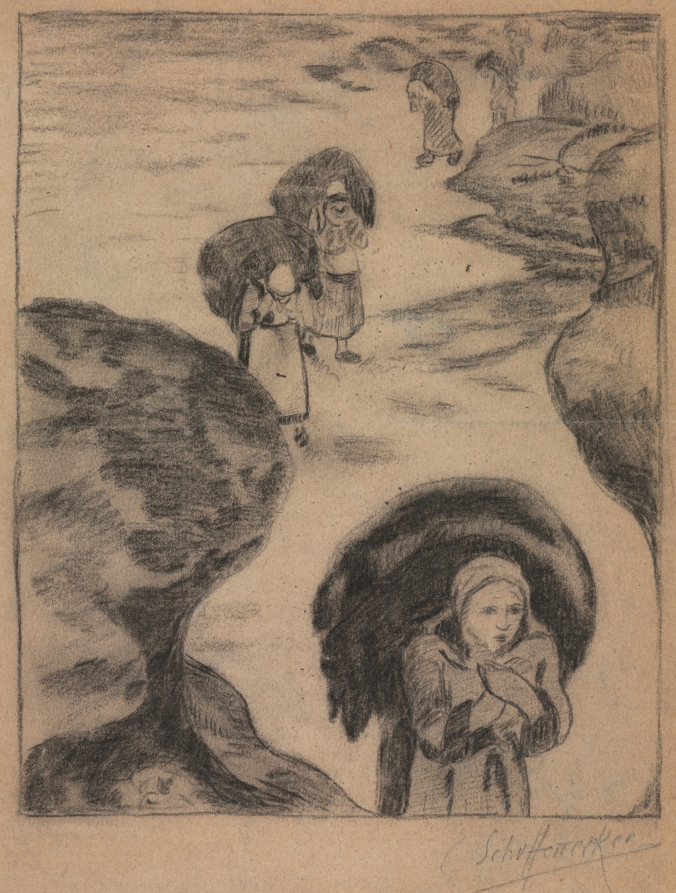
Seaweed Gatherers, Yport
Claude-Emile SchuffeneckerLinkedCulture matchlcp-108363156d7e
- Date
- c. 1889
- Medium
- black chalk
- Culture
- France, 19th century
- Department
- Drawings
- Institution
- Cleveland Museum of Art
- Object ID
- 167712
From the Cleveland Museum of Art record
Claude-Emile Schuffenecker worked closely with Paul Gauguin to form Synthetism, a style of art that broke from Impressionism in favor of flat planes of bold color and invented subjects. This drawing, which exists in two versions, is one of Schuffenecker’s most important works from the period. The other interpretation (owned by the Art Institute of Chicago) was featured in an influential 1889 exhibition organized by Gauguin and Schuffenecker at the Café Volpini on the grounds of the Universal Exposition. Both artists saw imagery of seaweed gatherers—a task undertaken by working-class people in rural French coastal towns—as exemplifying the simplicity they sought in their art. This drawing is one of numerous depictions of seaweed gatherers that Claude-Emile Schuffenecker created throughout his career in various media.
The authoritative record is held by Cleveland Museum of Art. LinkedCulture surfaces this object and its connections; it does not alter institutional metadata.
Get printable QR codesHide QR codes
Open QR codes for this object page and the museum record. They stay collapsed until needed.
Provenance & credit
As published by the source institution. Coverage varies — not every institution's open-data feed includes ownership history.
- Credit line
- Gift from Samuel and Paul Josefowitz in tribute to Jane Glaubinger and Heather Lemonedes
- Provenance
- ?-?: Paul Schuffenecker, Paris | ?-?: M. Bruyère, Namur, France | ?-?: M. Jean Willems, Brussels | by 1989-1990: (Shepherd Gallery, New York, NY) | 1990-?: (Paul Prouté, Paris) | after 1990-2009: Samuel Josefowitz, Lausanne, Switzerland, given to the Cleveland Museum of Art, Cleveland, OH | 2000-: Cleveland Museum of Art, Cleveland, OH
Related across collections
Semantically similar works from Cleveland Museum of Art and other institutions.