Cleveland Museum of Art
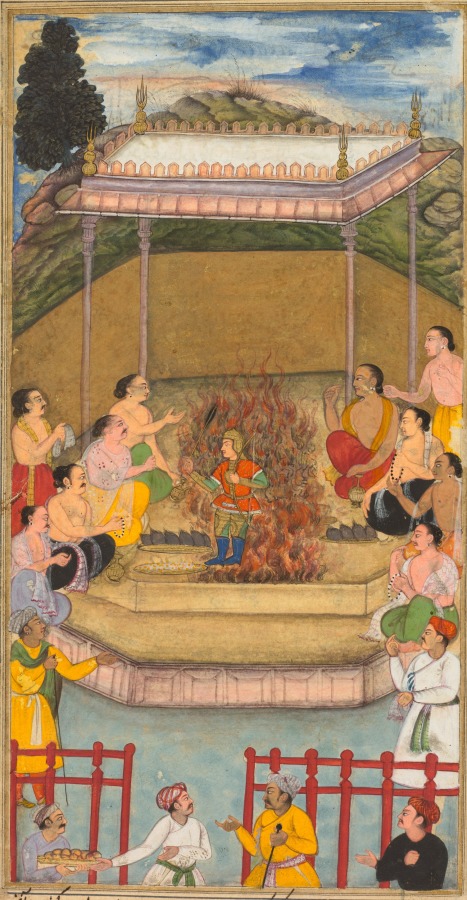
Yaja and Upayaja perform a sacrifice for the emergence of Dhrishtadyumna from the fire, from Adi-parva (volume one) of the Razm-nama (Book of Wars) adapted and translated into Persian by Mir Ghiyath al-Din Ali Qazvini, known as Naqib Khan (Persian, d. 1614) from the Sanskrit Mahabharata
Bilal HabshiLinkedCulture matchlcp-35696e87383e
- Date
- 1598
- Medium
- Gum tempera, ink, and gold on paper
- Culture
- Mughal India
- Department
- Indian and Southeast Asian Art
- Institution
- Cleveland Museum of Art
- Object ID
- 170804
From the Cleveland Museum of Art record
Fire sacrifice was central to the Indo-European people who entered the Indian subcontinent as early as 1800 BC. Only Brahmins, a social class of priests, had access to the sacred texts called the Vedas, which explained the meaning and process of the fire sacrifice, considered by orthodox Hindus as a way to communicate with the gods. A king named Drupada in ancient India sponsored this fire sacrifice in order to generate a powerful warrior who would be able to slay the enemy who took half his kingdom. Seated around an altar in the sacrificial enclosure, Brahmins pour oblations into the fire and recite the prayers necessary to generate the divine warrior Dhrishtadyumna, shown here in full battle armor at birth. The inscription below gives the title and the name of the artist, Habshi, which means “Ethiopian,” suggesting the presence of Africans in the royal Mughal workshop. The story of how the warrior Dhrishtadyumna was generated from the fire sacrifice is written on this page. When King Drupada lost half his kingdom to a military master named Drona, he needed a gift from the gods to defeat him: a new warrior born to accomplish this mission. In order to obtain this gift, King Drupada went to the banks of the Ganges to find two powerful Brahmins to whom the gods would respond favorably. After serving them faithfully and offering payment of 100,000 cows, the Brahmins Yaja and Upayaja agreed to perform the sacrifice. The text is written in a form of Arabic script, called naskh, in the Persian language, as translated from the original Sanskrit epic Mahabharata for emperor Akbar (r. 1556¬–1605). The passages of dialogue are written diagonally.
The authoritative record is held by Cleveland Museum of Art. LinkedCulture surfaces this object and its connections; it does not alter institutional metadata.
Get printable QR codesHide QR codes
Open QR codes for this object page and the museum record. They stay collapsed until needed.
Provenance & credit
As published by the source institution. Coverage varies — not every institution's open-data feed includes ownership history.
- Credit line
- Gift in honor of Madeline Neves Clapp; Gift of Mrs. Henry White Cannon by exchange; Bequest of Louise T. Cooper; Leonard C. Hanna Jr. Fund; From the Catherine and Ralph Benkaim Collection
Related across collections
Semantically similar works from Cleveland Museum of Art and other institutions.