Cleveland Museum of Art
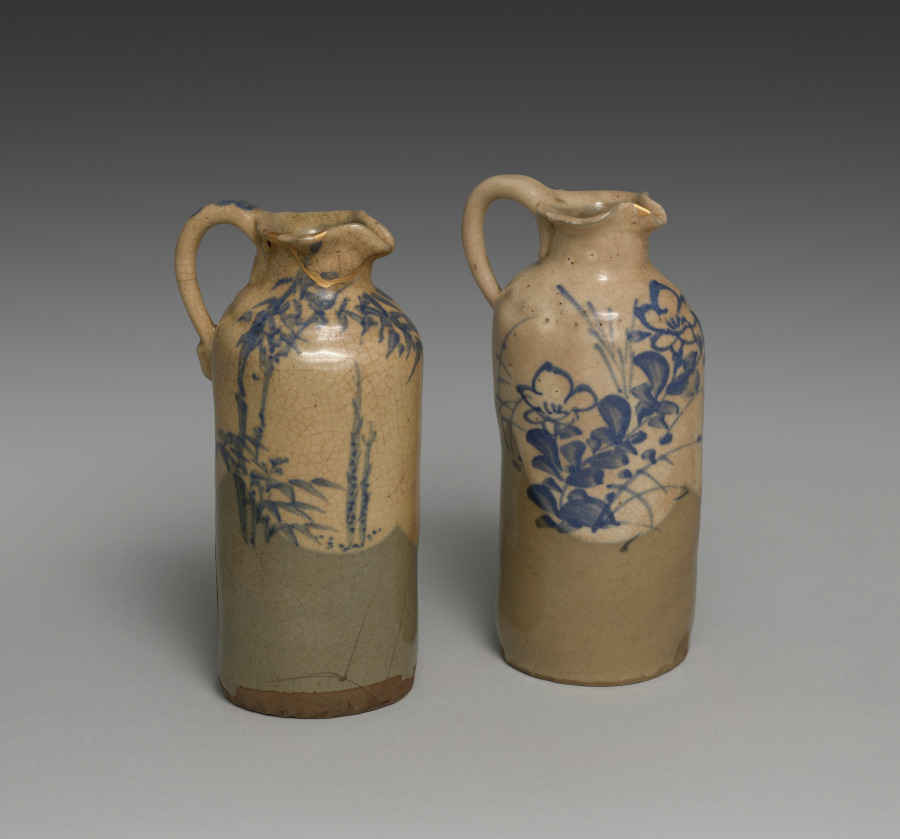
Sake Pourers with Bamboo and Bellflowers
Seifū Yohei ILinkedCulture matchlcp-a50cb2e844c7
- Date
- c. 1844–57
- Medium
- pair of sake pourers; stoneware with white slip, underglaze blue and gold repair (kintsugi) (Kyoto ware)
- Culture
- Japan, Edo period (1615–1868)
- Department
- Japanese Art
- Institution
- Cleveland Museum of Art
- Object ID
- 447012
From the Cleveland Museum of Art record
This pair of sake pourers adorned with with bamboo and bellflowers is attributed to the founder of the Seifū Studio, Seifū Yohei I (1801–1861). Yohei I, the lineage founder, was born to the Yasuda family in the city of Kanazawa, which faces the Sea of Japan. His home province of Kaga (in present-day Ishikawa Prefecture) produced its own ceramics, known as Kutani ware, but for his training as a potter, Yohei I chose Kyoto, which produced the more technically advanced porcelain ware. He moved to Kyoto around the 1820s and became apprenticed to Nin’ami Dohachi, a leading potter in the city. He later struck out on his own, and it is likely that his teacher gave him the name Seifu Yohei. His works include many exquisitely painted copies of Chinese porcelain, and he also produced stoneware with overglaze color enamels that emulated works in the style of Ogata Kenzan (1663–1743) at which his teacher excelled. The two pourers are stored together in a bespoke box, which is inscribed and impressed with red seals.
The authoritative record is held by Cleveland Museum of Art. LinkedCulture surfaces this object and its connections; it does not alter institutional metadata.
Get printable QR codesHide QR codes
Open QR codes for this object page and the museum record. They stay collapsed until needed.
Provenance & credit
As published by the source institution. Coverage varies — not every institution's open-data feed includes ownership history.
- Credit line
- Gift of James and Christine Heusinger
Related across collections
Semantically similar works from Cleveland Museum of Art and other institutions.