Cleveland Museum of Art
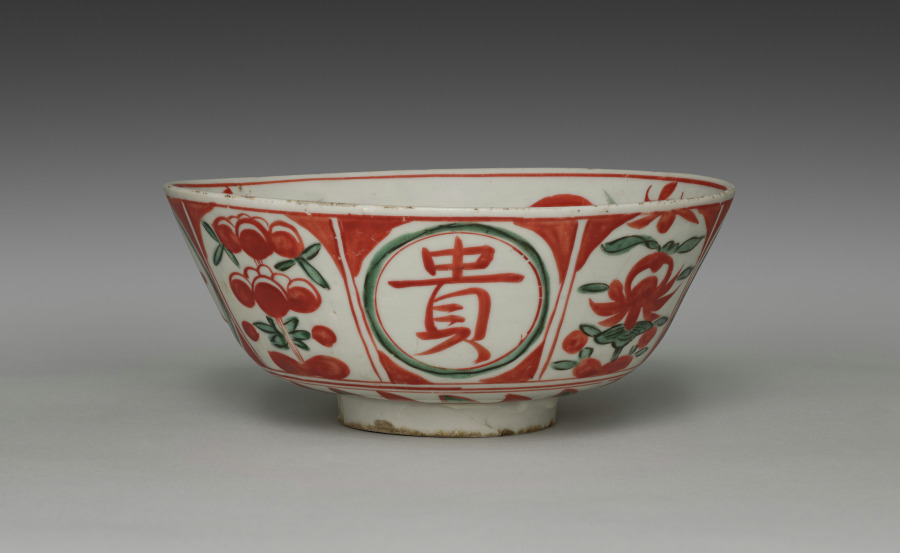
Bowl with Auspicious Ideographs and Floral Motifs
- Date
- 1600s
- Medium
- Stoneware with overglaze color enamels
- Culture
- China, Ming dynasty (1368–1644)
- Department
- Chinese Art
- Institution
- Cleveland Museum of Art
- Object ID
- 447838
From the Cleveland Museum of Art record
As part of their work, members of the Seifu studio, and Seifū Yohei III (三代清風与平, Japanese, 1851–1914), in particular, engaged in the viewing and appreciation of Chinese ceramics. While they were not authenticators, they would have been familiar with imported examples of Chinese stoneware and porcelain through tea gatherings, meetings with their elite clients, exhibitions, and other opportunities to see and study actual pieces from the mainland. This object and its box may be a reflection of Yohei III’s experiences of this kind. The bowl itself is slightly misshapen and roughly glazed with overglaze color enamels in red and green. Flanked by floral motifs, four Chinese characters brushed in red appear in roundels: 長命富貴. Meaning, respectively, longevity, life, prosperity, and status, they are pronounced together in Japanese as the phrase chōmeifūki , or “live long and prosper.” Additional loosely painted foliate designs in red and green circle the area above the foot and inside of the bowl. It is a relatively simple piece made by someone who was likely capable of much finer, more precise work but who could also do completely passable wares on short order. Of greater interest is the storage box lid for this piece. It has an inscription by Yohei III, with his seal, declaring it to be a “sweets dish from southern China with color images.” On the reverse of the lid, Yohei has written his name and placed his Imperial Household Artist seal, but instead of writing “made by,” he wrote “saw this [ceramic].” To the left of this is another inscription in a different hand, stating that the piece is a work from southern China with red-painted designs, produced at the very end of the Ming dynasty. It is signed “Kushi Takushin 久志卓真," along with his seal. Kushi Takushin (1898–1973) was a Japanese musician and music critic, as well as an antiques researcher and authenticator. He was especially interested in Ming dynasty Chinese ceramics and wrote extensively on Chinese, Japanese, and Korean ceramics. Originally from Hokkaido, he was active in Kyoto and began collecting art at a young age. Both he and Yohei appreciated and commented upon the bowl, and perhaps they both owned it. Each roundel contains an auspicious word conveying good wishes for a long life and wealth.
The authoritative record is held by Cleveland Museum of Art. LinkedCulture surfaces this object and its connections; it does not alter institutional metadata.
Get printable QR codesHide QR codes
Open QR codes for this object page and the museum record. They stay collapsed until needed.
Provenance & credit
As published by the source institution. Coverage varies — not every institution's open-data feed includes ownership history.
- Credit line
- Gift of James and Christine Heusinger
- Provenance
- ?–2022: James and Christine Heusinger, Berea, OH, given to the Cleveland Museum of Art | 2022–: The Cleveland Museum of Art, Cleveland, OH
Related across collections
Semantically similar works from Cleveland Museum of Art and other institutions.