Cleveland Museum of Art
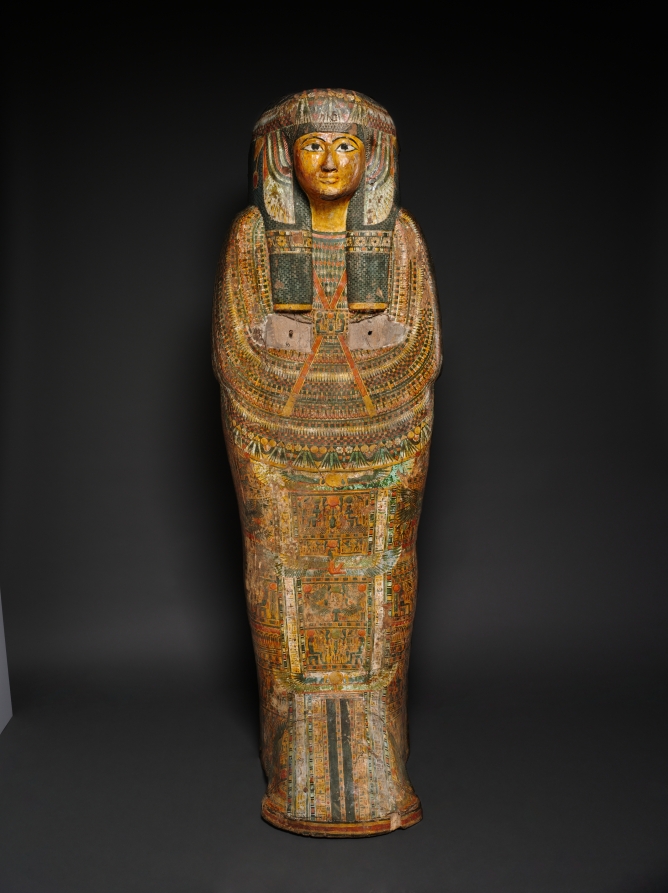
Coffin of Nesykhonsu (lid)
- Date
- c. 976–889 BCE
- Medium
- gessoed and painted sycamore fig
- Culture
- Egypt, Third Intermediate (1069–715 BCE), Dynasties 21–22
- Department
- Egyptian and Ancient Near Eastern Art
- Institution
- Cleveland Museum of Art
- Object ID
- 94190
From the Cleveland Museum of Art record
A complete set of coffins during the late New Kingdom and Third Intermediate Period consisted of an outer and inner coffin and a mummy board (essentially a lid without a case, placed directly over the wrapped mummy). Judging by its size, this must have been Nesykhonsu's outer coffin. The type is essentially the same as the coffin of Bakenmut, which was also an outer coffin. The two coffins are said to have been found together and to have belonged to a man and wife. This is quite possible, although the inscriptions do not bear it out. Bakenmut is not mentioned on Nesykhonsu's coffin, nor is she mentioned on his. There was by this time a tremendous repertoire of scenes appropriate for coffin decoration. Whereas Bakenmut's coffin features images of deified dead pharaohs, Nesykhonsu's is decorated in a more personal way with scenes from her own funeral. The main scene in the interior (near the top) shows a priest clad in a panther skin with the mummy of Nesykhonsu behind. The god appears in mummy form and wears a sun disk on his head. The scarab beetle inside the sun disk identifies him as Khepri, the morning sun, and the hieroglyphs to the right identify him as Atum, the evening sun. Taken together, image and text represent the sun god in both his rising and setting, youthful and aged aspects. Two of Nesykhonsu's titles, "Lady of the House" and "Singer of the Choir of Mut the Great," are written on the outside of the coffin.
The authoritative record is held by Cleveland Museum of Art. LinkedCulture surfaces this object and its connections; it does not alter institutional metadata.
Get printable QR codesHide QR codes
Open QR codes for this object page and the museum record. They stay collapsed until needed.
Provenance & credit
As published by the source institution. Coverage varies — not every institution's open-data feed includes ownership history.
- Credit line
- Gift of the John Huntington Art and Polytechnic Trust
- Provenance
- Thebes, probably Deir el-Bahri. Purchased from Joseph Hassan Ahmed, Luxor, by Lucy Olcott Perkins through Henry W. Kent
Part of a LinkedCulture topic
 Ancient Egyptian Personal Objects
These objects are cosmetic implements and grooming tools from ancient Egypt, including mirrors, palettes for grinding pigments, and decorative knives, representing daily life and personal adornment practices.
476 objects from 5 institutions
Related across collections
Semantically similar works from Cleveland Museum of Art and other institutions.