Cleveland Museum of Art
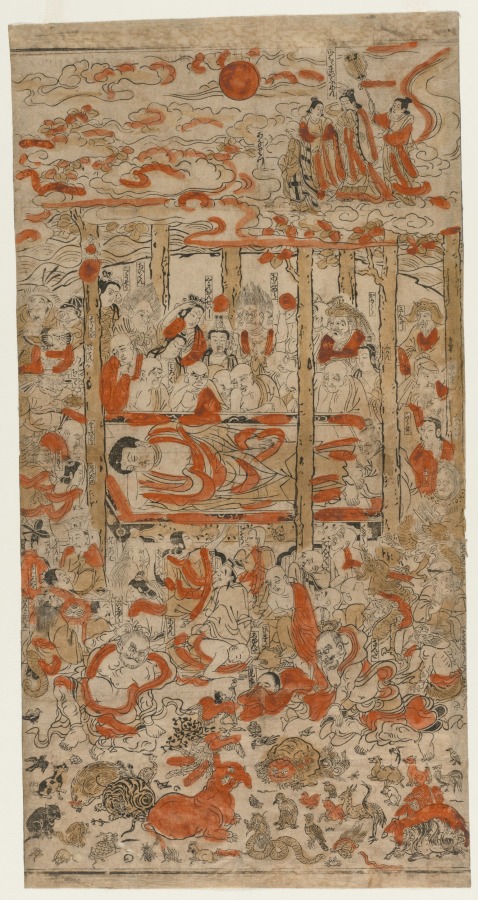
The Parinirvana of the Buddha
- Date
- c. 1710s
- Medium
- color woodblock print
- Culture
- Japan, Edo period (1615–1868)
- Department
- Japanese Art
- Institution
- Cleveland Museum of Art
- Object ID
- 95388
From the Cleveland Museum of Art record
This print records a religious rather than secular event, depicting the transition of the historical Buddha Shakyamuni from mortal to eternal being. On a cloudy night under a full moon, the Buddha lies on a platform on his right side with his right hand behind his head. His followers surround him in various states of grief, curiosity, or calm acceptance. An old woman at the Buddha’s feet and other lay believers are present, along with a host of Buddhist deities. The Buddha’s mother, two attendants, and a monk appear at the upper right. The multitude of animals acknowledges that the Buddha’s law applies to all living creatures. Note that various rectangular cartouches identify the followers. This rare image is the earliest hand-colored print in the museum collection. It was hand-colored in yellow and red (tan), and in many instances, the coloring does not follow the outlines of the key block. All printed versions of this subject are based on earlier paintings; the earliest woodcut of this event dates to 1402.
The authoritative record is held by Cleveland Museum of Art. LinkedCulture surfaces this object and its connections; it does not alter institutional metadata.
Get printable QR codesHide QR codes
Open QR codes for this object page and the museum record. They stay collapsed until needed.
Provenance & credit
As published by the source institution. Coverage varies — not every institution's open-data feed includes ownership history.
- Credit line
- Gift of Mr. and Mrs. J. H. Wade
- Provenance
- ?–1916: Mr. Jeptha Homer Wade II [1857-1926] and Mrs. Ellen Garretson Wade [1859-1917], Cleveland, OH, given to the Cleveland Museum of Art | 1916–: The Cleveland Museum of Art, Cleveland, OH
Part of a LinkedCulture topic
 Buddhist and Hindu Iconography
These objects are connected by their representation of sacred figures and deities from Buddhist and Hindu religious traditions across Asian cultures, including sculptures, paintings, and ritual objects depicting buddhas,
183 objects from 5 institutions
Related across collections
Semantically similar works from Cleveland Museum of Art and other institutions.