Cleveland Museum of Art
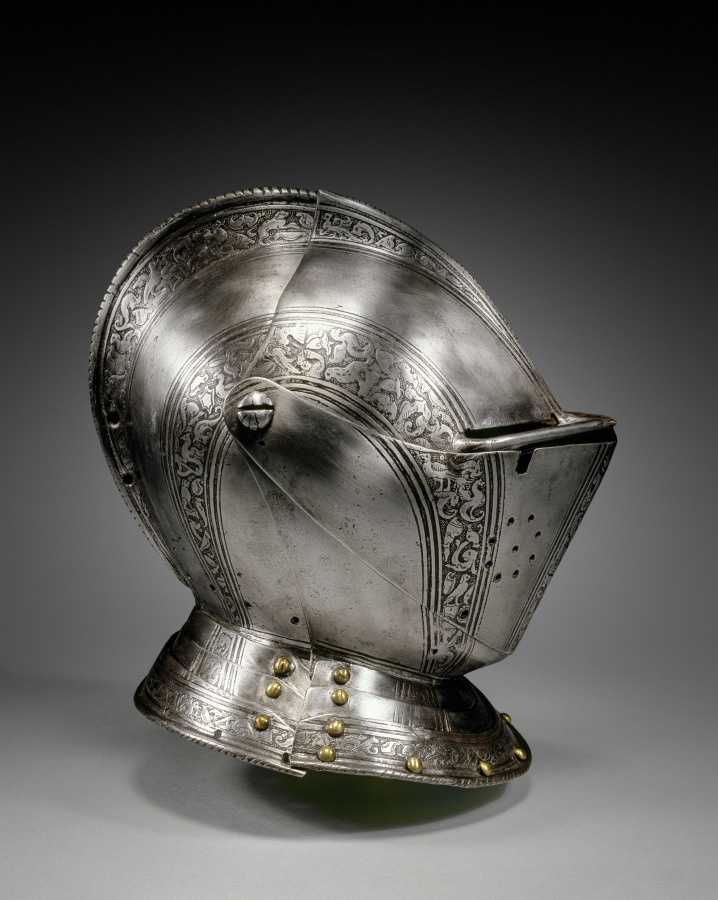
Close Helmet
- Date
- c. 1575
- Medium
- steel with etched decorative bands and roundels
- Culture
- North Italy, Brescia (?), 16th century
- Department
- Medieval Art
- Institution
- Cleveland Museum of Art
- Object ID
- 96077
From the Cleveland Museum of Art record
Decoration was critical to fine armor, and etching was the most commonly used technique. Here, the bands along the borders are etched. On the breastplate, pauldrons (shoulder guards), and tassets (hip and upper leg guards), etched medallions enclose profile busts reminiscent of ancient Roman portraits. The lance rest on the breastplate indicates that this half-suit was once part of a complete field armor for man and horse. The etching technique used for armor was developed in the late 1400s. The metal surface was first coated with an acid-resistant substance, such as wax or varnish. An etching needle was then used to scratch a design into the surface. The exposed areas were then treated with an acid that would "bite" or etch the lines into the metal. When the coating was removed, the etched design was blackened for contrast. Etching, by far the most common technique for armor decoration, involved the use of a graving tool assisted by acid to create a design. The etched design could then be blackened to create contrast as shown here.
The authoritative record is held by Cleveland Museum of Art. LinkedCulture surfaces this object and its connections; it does not alter institutional metadata.
Get printable QR codesHide QR codes
Open QR codes for this object page and the museum record. They stay collapsed until needed.
Provenance & credit
As published by the source institution. Coverage varies — not every institution's open-data feed includes ownership history.
- Credit line
- Gift of Mr. and Mrs. John L. Severance
- Provenance
- Duc d'Osuna | ?-1916: Frank Gair Macomber (1849-1941), Boston, MA, sold to the Cleveland Museum of Art | 1916-: The Cleveland Museum of Art, Cleveland, OH
Part of a LinkedCulture topic
 European Renaissance Armor Components
These objects are all pieces of defensive armor and military equipment from 15th-17th century Europe, primarily from major armoring centers like Italy, Germany, and France.
500 objects from 4 institutions
Related across collections
Semantically similar works from Cleveland Museum of Art and other institutions.