Cleveland Museum of Art
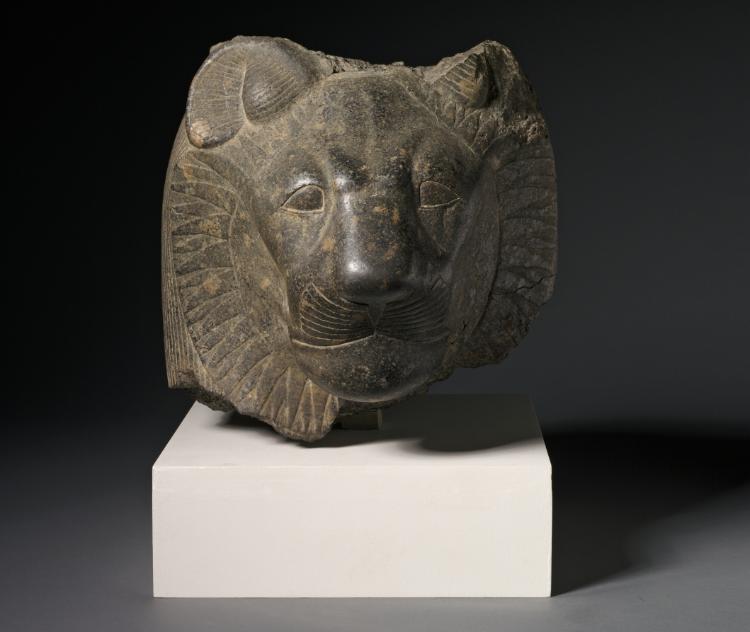
Head of Sekhmet
- Date
- c. 1391–1353 BCE
- Medium
- granodiorite
- Culture
- Egypt, Thebes(?), New Kingdom (1540–1069 BCE), Dynasty 18, reign of Amenhotep III (1390–1352 BCE)
- Department
- Egyptian and Ancient Near Eastern Art
- Institution
- Cleveland Museum of Art
- Object ID
- 96303
From the Cleveland Museum of Art record
This lioness head once belonged to a grand statue of the goddess Sekhmet, "the powerful one," probably seated and wearing a tight dress. Possibly appealing to her healing aspect, Pharaoh Amenhotep III, often described as “beloved of Sekhmet,” commissioned and dedicated hundreds of large granodiorite Sekhmet sculptures in his Theban mortuary temple. Thus, this head likely comes from Thebes, perhaps later moved across the Nile—like many such sculptures—to the temple of Mut, a related deity, at Karnak. Behind her stylized ruff, Sekhmet wears a wig, once crowned with a sun disk and uraeus, the stylized cobra symbolizing royal or divine power. Amenhotep III may have dedicated 730 statues of Sekhmet, two for each day of the year.
The authoritative record is held by Cleveland Museum of Art. LinkedCulture surfaces this object and its connections; it does not alter institutional metadata.
Get printable QR codesHide QR codes
Open QR codes for this object page and the museum record. They stay collapsed until needed.
Provenance & credit
As published by the source institution. Coverage varies — not every institution's open-data feed includes ownership history.
- Credit line
- Gift of the John Huntington Art and Polytechnic Trust
- Provenance
- Presumably Thebes. Purchased from Paul Mallon. Formerly in the collection of Comte Le Marois, Normandy ("For the Egyptian Head of Lion, it comes from the own collection of Comte Demaroix [sic]," letter from Mallon, 1 March 1916, CMA Archives)
Part of a LinkedCulture topic
 Ancient Egyptian Personal Objects
These objects are cosmetic implements and grooming tools from ancient Egypt, including mirrors, palettes for grinding pigments, and decorative knives, representing daily life and personal adornment practices.
476 objects from 5 institutions
Related across collections
Semantically similar works from Cleveland Museum of Art and other institutions.