Getty Museum
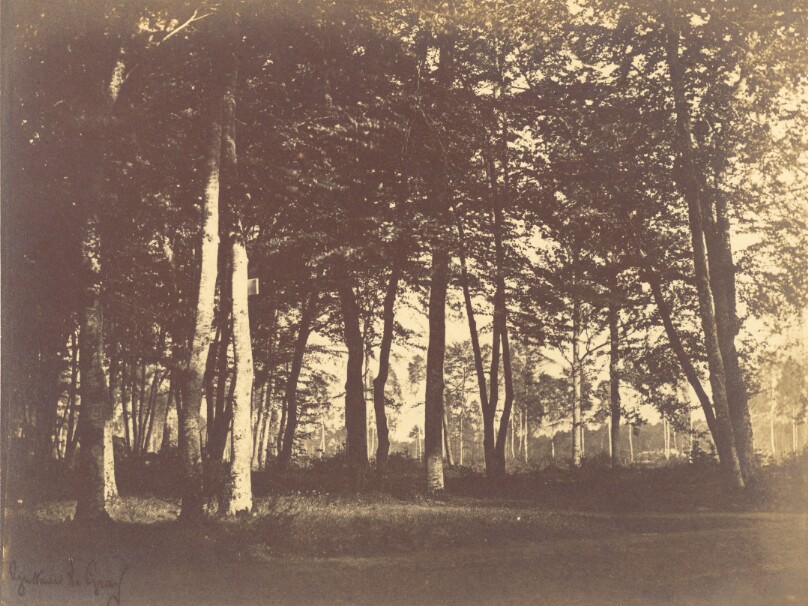
Curtain of Trees
Creator
Gustave Le GrayFrench Photographer · 1820–1884
All works by this person →Though he was trained as a painter, Gustave Le Gray made his mark in the emerging medium of photography. An experimenter and technical innovator, Le Gray pioneered the use of the paper negative in France and developed a waxed-paper negative that produced sharper-focus prints. In 1851 he began to use collodion on glass negatives, which further increased the clarity of his images. He became one of t
More on Getty ULAN- Date
- about 1849
- Medium
- Salted paper print from a paper negative
- Culture
- French
- Department
- Photographs
- Institution
- Getty Museum
- Object ID
- 0ad5010c-bfa7-43bd-a67a-6439541d95d6
From the Getty Museum record
> From the late 1840s through the early 1850s Gustave Le Gray continued to expand his teaching activities, his experimentation, and his publication of new treatises on photographic processes. He also took frequent trips to the forest of Fontainebleau to create artistic views of the area. He probably made some of these expeditions in the company of other photographers such as Charles Nègre, Henri Le Secq, and his student John B. Greene. Fontainebleau and nearby Barbizon were already well-explored sites for Barbizon School painters along with Le Gray's comrades Pierre-Antoine Labouchére and Jean-Léon Gérôme from the studio of Paul Delaroche. Photo historian Sylvie Aubenas argues that Le Gray's choice of artistic subject speaks to his desire to set himself apart from commercial photographers and align himself with fine artists. > > When Le Gray made *Curtain of Trees* around 1849, the chemistry of the photographic negative was not sensitive to the color green, so the foliage appears darker in the photograph than it would have in real life. On the other hand, the light sensitive chemicals were oversensitive to blue. Le Gray cleverly chose a time of day when the sun was lower in the sky (so there was less blue in the light) and when he could take advantage of the raking angle of the sun's rays that dramatically highlighted some of the trunks. > > If one takes a close look at the brilliantly illuminated white trees on the left of the image, high upon the right side of the tree trunk is a marker for tourists, who would have been following a carefully prescribed path from a guidebook, by authors such as C. F. Denencourt, through the Forest of Fontainebleau. In the mid-nineteenth century, the forest was an extremely popular destination for artists as well as other Parisians wanting to take respite from the city. This view may, in fact, show a site quite near another Le Gray's photograph, *The Road to Chailly, Fontainebleau* ([84.XM.347.3](http://www.getty.edu/art/collection/objects/61910)); the clearing here in the distance suggests that Le Gray was not far from such a road. Adapted from getty.edu, Interpretive Content Department, 2008; Weston Naef, *The J. Paul Getty Museum Handbook of the Photographs Collection* (Los Angeles: J. Paul Getty Museum, 1995), 50, © 1995 The J. Paul Getty Museum; and Sylvie Aubanas, *Gustave Le Gray, 1820-1884* (Los Angeles: The J. Paul Getty Museum, 2002), © 2002 J. Paul Getty Trust. For more information about the author and this piece, see: Aubanas, Sylvie. *Gustave Le Gray, 1820-1884.* Los Angeles: The J. Paul Getty Museum, 2002. Parry Janis, Eugenia. *The Photography of Gustave Le Gray*. Chicago: The Art Institute of Chicago and The University of Chicago, 1987.
The authoritative record is held by Getty Museum. LinkedCulture surfaces this object and its connections; it does not alter institutional metadata.
Get printable QR codesHide QR codes
Open QR codes for this object page and the museum record. They stay collapsed until needed.
Related across collections
Semantically similar works from Getty Museum and other institutions.