Getty Museum
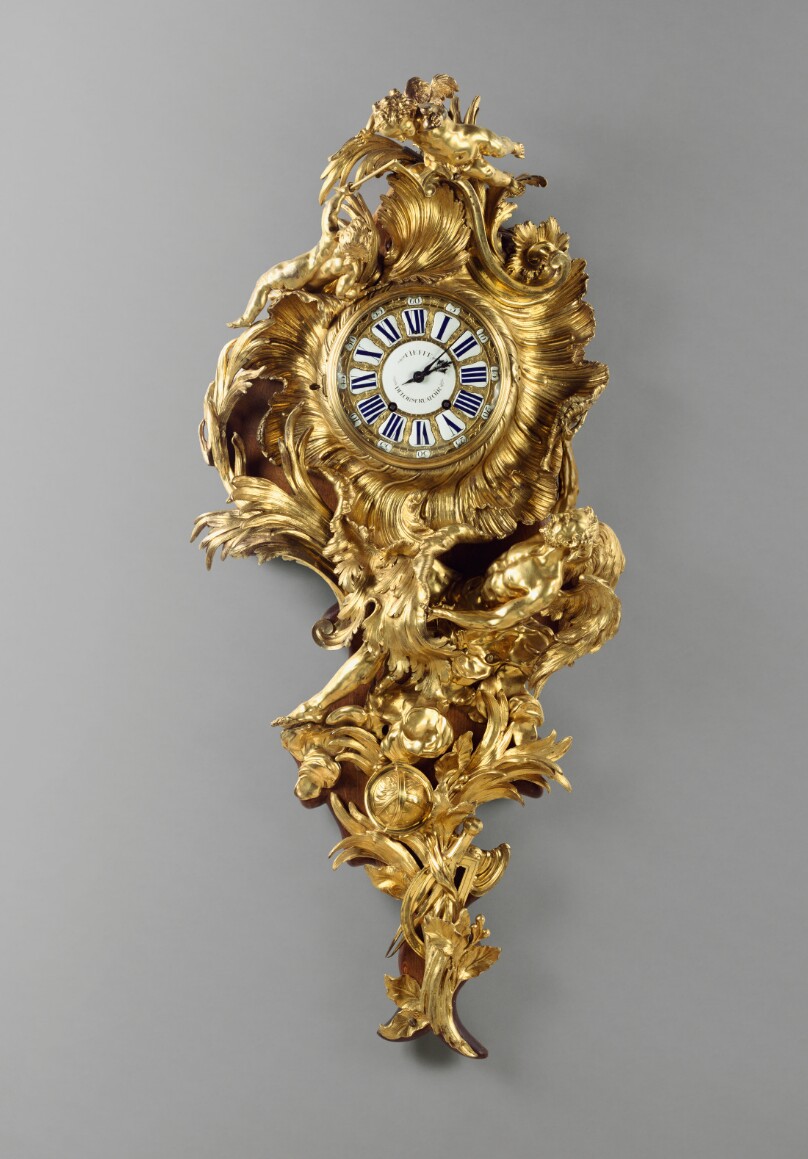
Wall Clock (Pendule)
- Date
- about 1735–1740
- Medium
- Gilt bronze, enameled metal, wood carcass, glass
- Culture
- French
- Department
- Decorative Arts
- Institution
- Getty Museum
- Object ID
- 17f6c3ff-0e58-42df-ba1c-55f4d2d2a351
From the Getty Museum record
The clock's swirling leaves and asymmetrical overall design are typical of the work of Juste-Aurèle Meissonnier, a designer and goldsmith and one of the leading exponents of the Rococo style. In an engraved book of Meissonnier's works, published about 1750, the antechamber wall in a cross-section of a house features a large clock with a reclining figure below the dial positioned like that on the Getty Museum's clock. Such clocks, also known as *pendules d'alcove* (alcove clocks), were usually small, suitable for hanging in an alcove above a bed. The repeating mechanisms that chimed the nearest hour and quarter hour when a string was pulled eliminated the need to light a candle to see the dial. They also prevented the constant chiming that would awaken a sleeper. This is the largest known example of the *pendule d'alcove,* indicating that it was made for an extremely imposing interior. The figures on this clock represent Love conquering Time, a theme often repeated on mid-eighteenth century French clocks. The two cherubs above carry away the scythe and hourglass, the symbols of Time, while Time himself lies vanquished below with his globe, protractor, and pair of compasses.
The authoritative record is held by Getty Museum. LinkedCulture surfaces this object and its connections; it does not alter institutional metadata.
Get printable QR codesHide QR codes
Open QR codes for this object page and the museum record. They stay collapsed until needed.
Related across collections
Semantically similar works from Getty Museum and other institutions.