Getty Museum
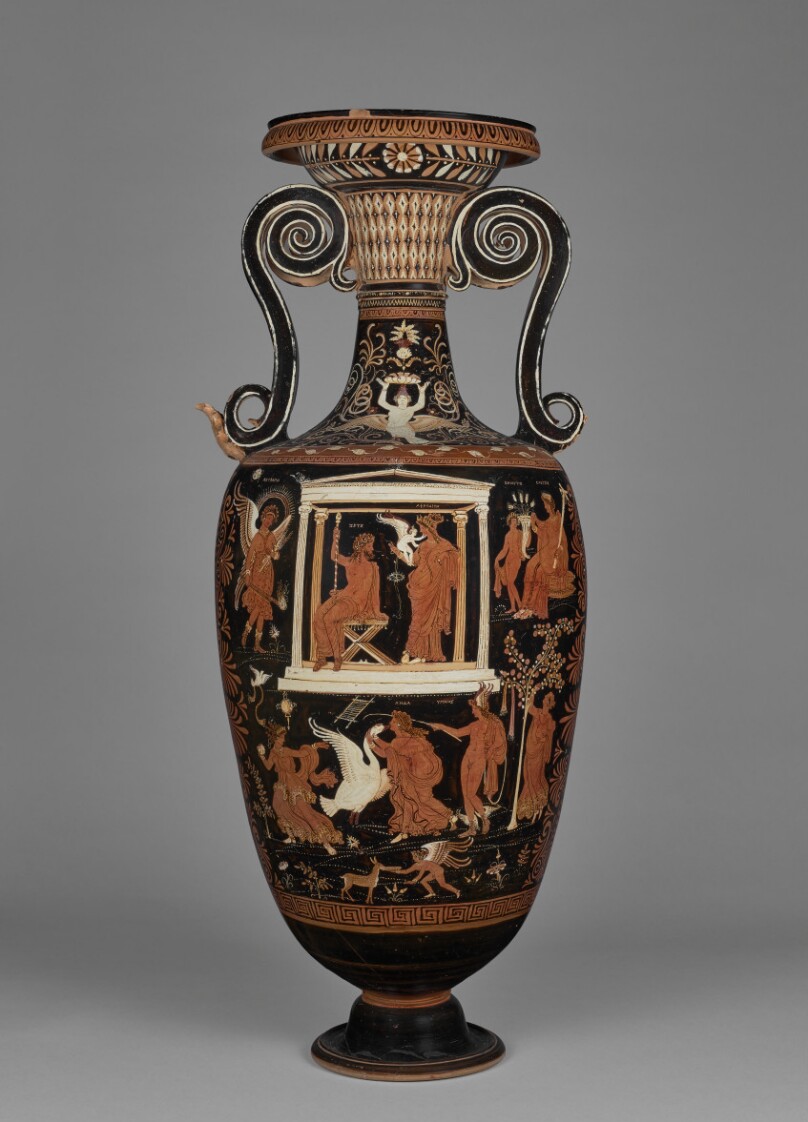
Apulian Red-Figure Loutrophoros
Creator
Painter of Louvre MNB 1148Painter
All works by this person →The Painter of Louvre MNB 1148 is the name of an artist who decorated pottery using the red-figure technique in Apulia in southern Italy. A follower of the Varrese Painter, the Painter of Louvre MNB 1148 worked in the period around 350 B.C. As with most vase-painters, his real name is unknown, and he is identified only by the stylistic traits of his work. He is named for one of his vases, now in t
More on Getty ULAN- Date
- about 330 B.C.
- Medium
- Terracotta
- Culture
- Greek (South Italian, Apulian)
- Department
- Vessels
- Institution
- Getty Museum
- Object ID
- 1c7397a5-5b0f-41d3-8c53-908d18dc6671
From the Getty Museum record
With elaborate scenes on both sides, this loutrophoros or ritual vase is characteristic of the work of vase painters in southern Italy around 330 B.C. It was made for the grave and has a hole in the bottom, so could not have served as a container. It was instead a showpiece, made to be seen by mourners. On the shoulder of the vessel stands a Siren. Part bird, part woman, the mythical figure is a symbol of grief and lamentation. The multilevel composition on the front shows two successive moments. Above, Zeus, the king of the gods meets with Aphrodite to enlist her help. The goddess of desire, accompanied by Eros, carries an *iynx*, a wheel-shaped form on strings that served as a love-charm. To the left, bearing a flaming torch and thunderbolt, is Astrape, the personification of lighting and attendant to Zeus. To the right sits Eleusis, the personification of the Greek town that was home to the Eleusinian Mysteries, an annual festival that promised its initiates good harvests and a happy afterlife. She is accompanied by a young boy bearing a cornucopia full of wheat. Conveying the idea of agricultural fertility and so an appropriate companion for Eleusis, he is named as Eniautos, the personification of the Year. Below, Zeus reappears in the form of a swan and kisses the Spartan queen Leda. Hypnos, the personification of Sleep, assists Zeus and stretches out his staff as though to dull Leda’s senses. Further to the right, a woman, presumably one of Leda's companions, plucks fruit from a tree, seemingly oblivious to the events, while at the left, another girl flees from the scene in fright. The reverse of the vase, like so many Apulian vessels made for funerals, depicts a grave monument (*naiskos*). Within stands a young woman—presumably the deceased—holding a ball of thread, surrounded by visitors bringing gifts to the grave. Given this explicit funerary context, the depiction of Zeus and Leda on the front may go beyond a simple representation of the myth. Images of individuals being carried off or seduced by gods often seem to have served as consolatory metaphors for death in Apulian vase-painting, and the funerary aspect here is further suggested by Eleusis, given her association with rituals that promised a blessed existence after death.
The authoritative record is held by Getty Museum. LinkedCulture surfaces this object and its connections; it does not alter institutional metadata.
Get printable QR codesHide QR codes
Open QR codes for this object page and the museum record. They stay collapsed until needed.
Related across collections
Semantically similar works from Getty Museum and other institutions.