Getty Museum
Irmengard Codex
Creator
UnknownAll works by this person →More on Getty ULAN- Date
- text about 1030–1050; illumination shortly after 1053
- Medium
- Tempera colors, gold, and ink
- Culture
- German (Reichenau)
- Department
- Manuscripts
- Institution
- Getty Museum
- Object ID
- 1f7eef20-8297-4c31-be4e-8fe44ab58bba
From the Getty Museum record
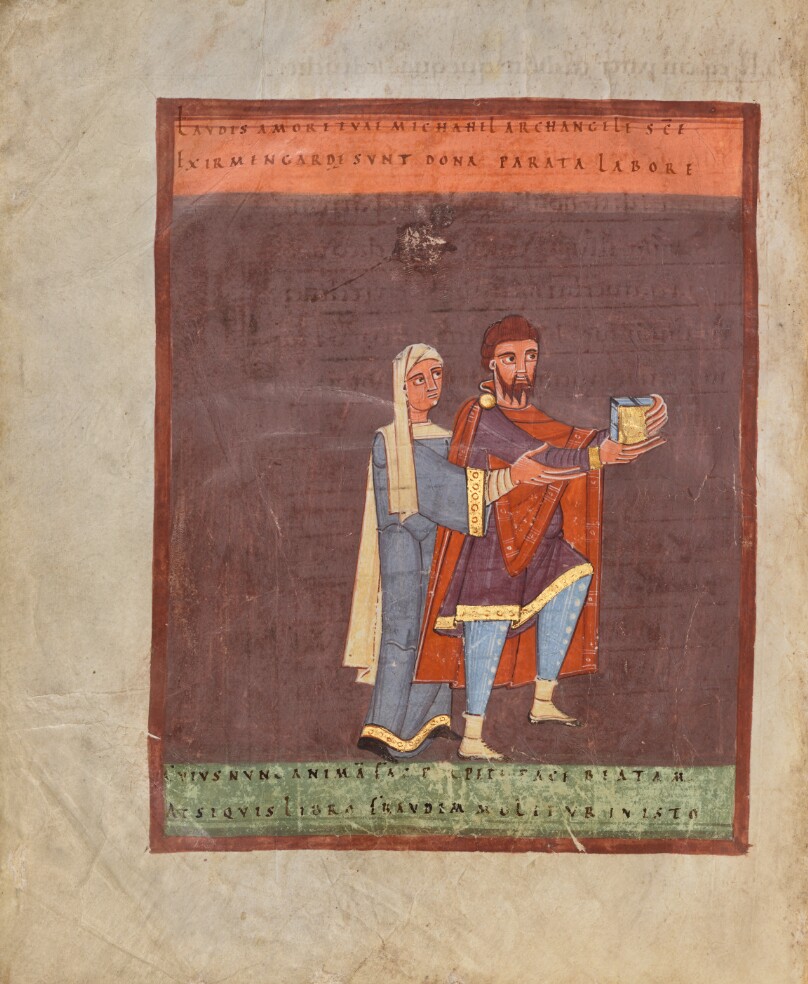
The Irmengard Codex, containing a series of readings for use during the celebration of Christian mass, was created at the famed Reichenau scriptorium in Germany in the middle of the eleventh century. The illumination program includes portraits of the four evangelists as well as narrative images that highlight the most important Christian feasts of the liturgical year. Some of the illuminations were conceived as double-page spreads, with the scene spanning both pages to form a single composition. Stately figures, ageless and immutable, stand out against simple backgrounds composed of pastel colors. They gesture performatively with long-fingered hands and stare from the page with oversized eyes. These powerful and theatrical figures underscore the stateliness of the Christian ceremony for which this book was created. A hallmark of Ottonian and Salian style was an emphasis on dramatic gesture and art that enabled mediation with the divine. Taking its name from three consecutive emperors named Otto who ruled in the 10th and early 11th century, the Ottonian era was a cultural epoch that continued into the Salian Dynasty, which ruled Germanic lands from 1024 to 1125. It is thought that the text of the Irmengard Codex was written out around 1030-50, but that the fifteen full-page miniatures were added shortly after 1053 at the behest of Irmengard of Nellenburg, the codex’s patron. During this period, women held significant political and financial power, prior to the significant Church reforms of the second half of the eleventh century that weakened female authority. Irmengard was a member of a powerful local ruling family, the House of Egisheim-Dagsburg. She was related to Pope Leo IX (1002-1054) and was also the niece of Holy Roman Emperor Henry II (973-1024). The illumination program culminates in an extremely rare dedication image of Irmengard presenting the book in memory of her deceased husband Werner and son Adalbert, who were killed in 1053 at the Battle of Civitate.
The authoritative record is held by Getty Museum. LinkedCulture surfaces this object and its connections; it does not alter institutional metadata.
Get printable QR codesHide QR codes
Open QR codes for this object page and the museum record. They stay collapsed until needed.
Related across collections
Semantically similar works from Getty Museum and other institutions.