Getty Museum
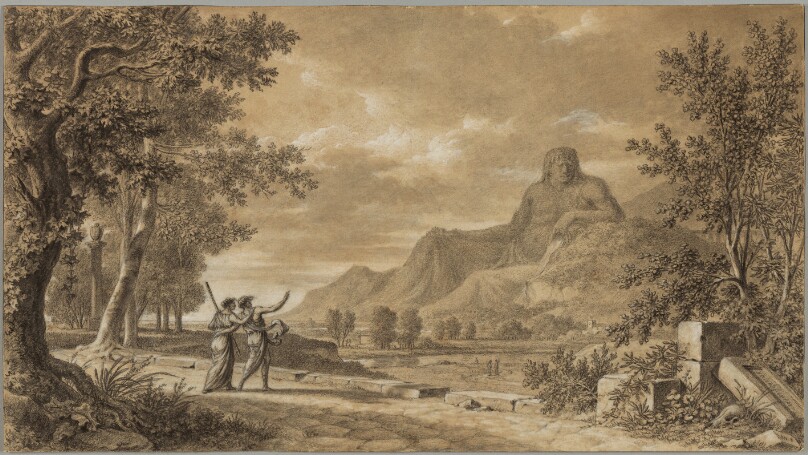
Mount Athos Carved as a Monument to Alexander the Great
Creator
Pierre-Henri de ValenciennesFrench Artist · 1750–1819
All works by this person →Like many French artists of the 1700s, Pierre-Henri de Valenciennes was drawn to Rome. After studying painting in his hometown of Toulouse, Valenciennes visited Italy's capital in 1769 and spent much of the next two decades there. For the most part, he ignored the well-known monuments and panoramas, favoring humble vistas and ruins. He was not alone in this pursuit, but whereas other French artist
More on Getty ULAN- Date
- 1799–1800
- Medium
- Black and white chalk, on beige paper
- Culture
- French
- Department
- Drawings
- Institution
- Getty Museum
- Object ID
- 3276c9ae-412d-447d-a7b6-7d4cd6f7b6c6
From the Getty Museum record
Two figures in antique dress pause on a rustic road, turning their backs to the picture plane as they marvel at a colossal statue. Carved from the living rock of a mountain ridge, the reclining figure holds in one hand a city, and, in the other, an urn. From its mouth pours a bright cascade, feeding the river that winds along the valley floor and the bay that stretches into the distance at left. According to various classical authors, either the architect Dinocrates (Vitruvius, De Architectura, book II, introduction, section 3) or the sculptor Stasicrates (Plutarch, Life of Alexander, part 7, section 76) sought to curry favor with Alexander the Great by carving a colossal likeness of the Macedonian king into the side of Mount Athos. The project was never realized but is here imagined by Valenciennes—an avid reader of both Plutarch and Vitruvius—who likely adopted the pose of the colossus from an ancient sculpture of the Nile then in the Museo Pio Clementino (now in the Vatican Museums). Valenciennes had depicted the same theme twice before, but this carefully finished collector’s drawing offers his final, definitive treatment. Black chalk applied with varying pressure and density conveys a sense of the vast distance that separates shady foreground—all twisted roots and rustling leaves—from the mountainside and monolithic statue that seem to graze the clouds. Touches of white heightening illuminate the sky and caress the landscape with light, drawing the eye to a ruined wall in the right foreground, where a crooked slab bears Valencienne’s signature and the date “an 8”: 1799-1800 in the Revolutionary calendar.
The authoritative record is held by Getty Museum. LinkedCulture surfaces this object and its connections; it does not alter institutional metadata.
Get printable QR codesHide QR codes
Open QR codes for this object page and the museum record. They stay collapsed until needed.
Related across collections
Semantically similar works from Getty Museum and other institutions.