Getty Museum
Subgeometric Plate
Creator
Crane PainterPainter
All works by this person →- Date
- 660–640 B.C.
- Medium
- Terracotta
- Culture
- Etruscan (Caeretan)
- Department
- Vessels
- Institution
- Getty Museum
- Object ID
- 442388c0-447b-4a16-8b42-b8d2576bec29
From the Getty Museum record
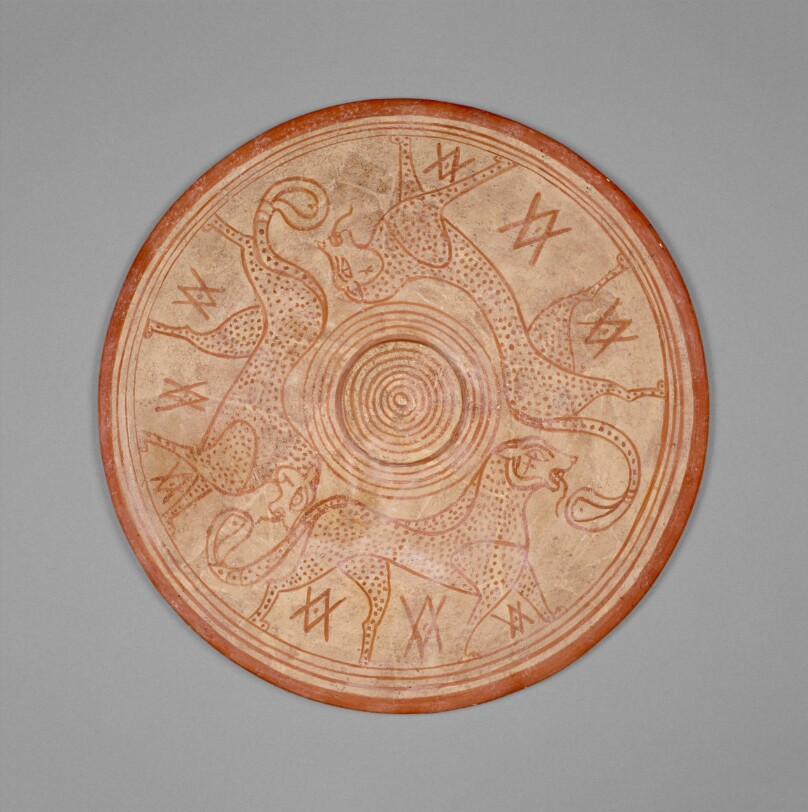
On the exterior of the plate is a frieze of three spotted panthers striding from left to right. Each feline has a large head with a prominent frontal eye and a long protruding tongue. The bodies, except for the heads, ears, and ends of the tails, are completely covered with dots that often follow the contours of the bodies. All three tails curve back on themselves to create the impression off a closed loop, reinforced by a single dot enclosed near the top of each loop. One panther also has an extra line painted above his back and filled in with dots to create a mane-like element, probably an error. Below, overlapping pairs of large Vs set in opposition to form diamond-like designs, each with a central dot. Four bands just above the painted edge of the foot; three similar bands, plus one wide band at the rim. Eight concentric bands, the outermost incomplete, on underside of the foot. The Etruscan name for this type of plate, "spanti," is inscribed on a few typical examples from Cerveteri and environs. The plates' function remains uncertain. It is likely that this Etruscan shape ultimately derives from eighth-century-B.C. Phoenician prototypes. Phoenician red-slip plates, which were imported to Etruria, are especially close in shape and share the frequent presence of similar concentric circles. Pioneering immigrant artisans were active in Cerveteri and Veii, influencing figured vases and tomb painting. Most plates are found in graves with larger vessels that comprise banquet sets.
The authoritative record is held by Getty Museum. LinkedCulture surfaces this object and its connections; it does not alter institutional metadata.
Get printable QR codesHide QR codes
Open QR codes for this object page and the museum record. They stay collapsed until needed.
Related across collections
Semantically similar works from Getty Museum and other institutions.