Getty Museum
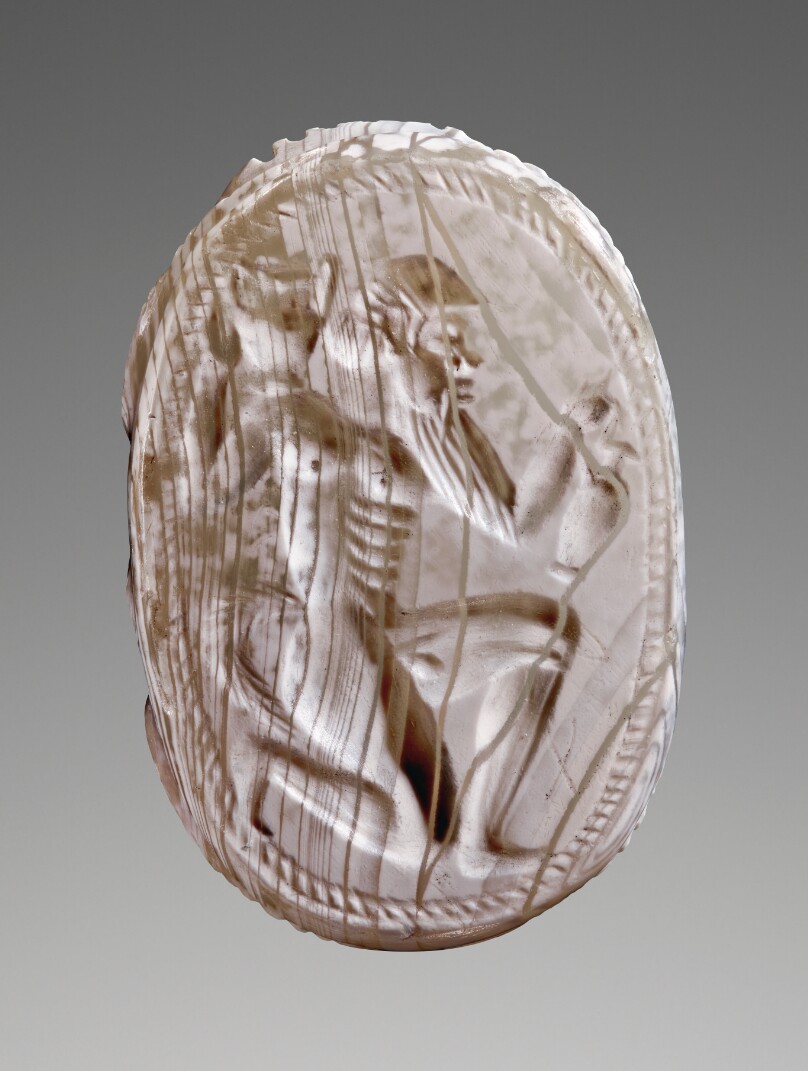
Engraved Scarab with Kneeling Satyr
Creator
Master of the London SatyrGreek Artist
All works by this person →- Date
- about 530 B.C.
- Medium
- Blue-grey chalcedony
- Culture
- Greek
- Department
- Jewelry
- Institution
- Getty Museum
- Object ID
- 4c8bf008-2db1-4ffb-8554-1c82a210d937
From the Getty Museum record
On this scarab, a mature satyr with full beard, pointed ears, and thick, bushy tail kneels in left profile with one knee on the ground. He balances an amphora on his left shoulder and holds a jug in his outstretched right hand, his torso twisting so that his upper chest faces entirely to the front in a manner typical of Archaic Greek art. The device seen here is a frequent type. Part man, part animal, satyrs are wild creatures, and the aggressive facial features of this example effectively convey his brutish nature. They are typically associated with Dionysos, the Greek god of wine, and are often shown drinking. Greek gem carving changed dramatically in form, materials, and technique in the-mid 500s B.C. One of these changes was the introduction of the scarab, with its back carved like a beetle and its flat surface an intaglio. They were usually pierced and worn either as a pendant or attached to a metal hoop and worn as a ring, with the beetle side facing out and the intaglio surface resting against the finger. When serving as a seal, the ring was removed, the scarab swiveled, and the intaglio design was pressed into soft clay or wax to identify and secure property. The scarab form originally derived from Egypt, where it had been used for seals and amulets for centuries. Certain features of Greek scarabs, however, such as the form of the beetle and the hatching around the intaglio motif, show the influence of Phoenician models, which the Greeks probably saw on Cyprus.
The authoritative record is held by Getty Museum. LinkedCulture surfaces this object and its connections; it does not alter institutional metadata.
Get printable QR codesHide QR codes
Open QR codes for this object page and the museum record. They stay collapsed until needed.
Related across collections
Semantically similar works from Getty Museum and other institutions.