Getty Museum
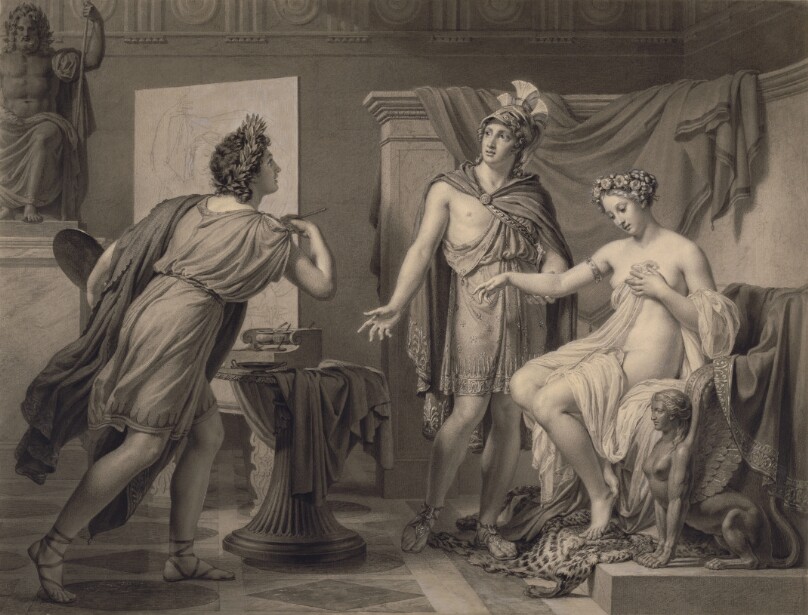
Alexander Ceding Campaspe to Apelles
Creator
Jérôme-Martin LangloisFrench Artist · 1778–1838
All works by this person →Jérôme-Martin Langlois's father was a miniature painter, yet he opposed his son taking up the artist's profession. Langlois persisted, however, and trained with Jacques-Louis David, France's leading painter. David's Neoclassical style strongly influenced Langlois, whose historical and mythological paintings were also characterized by severe settings and cool, polished rendering of form. Langlois u
More on Getty ULAN- Date
- 1819
- Medium
- Black and white chalk, gray washes, heightened with white gouache
- Culture
- French
- Department
- Drawings
- Institution
- Getty Museum
- Object ID
- 4d31b626-a52c-476a-81ce-5cdb909ef44e
From the Getty Museum record
In a famous, perhaps apocryphal story meant to illustrate the great ruler's generosity, the court painter Apelles fell in love with Alexander the Great's favorite concubine Campaspe while sketching her. As a mark of appreciation for the painter's work, Alexander gave her to him as a present. In this scene Apelles responds to his master with enthusiasm and gratitude, while Campaspe modestly clutches her drapery and gazes at the floor. Jérôme-Martin Langlois made this highly polished drawing in preparation for a painting that achieved great success at the Paris Salon of 1819. Using nearly invisible strokes, he expressed the varied textures of leopard skin and marble walls under a clear, cool light. As with many Neoclassical French painters, Langlois chose a classical subject and an austere setting as a moral lesson for his own time.
The authoritative record is held by Getty Museum. LinkedCulture surfaces this object and its connections; it does not alter institutional metadata.
Get printable QR codesHide QR codes
Open QR codes for this object page and the museum record. They stay collapsed until needed.
Related across collections
Semantically similar works from Getty Museum and other institutions.