Getty Museum
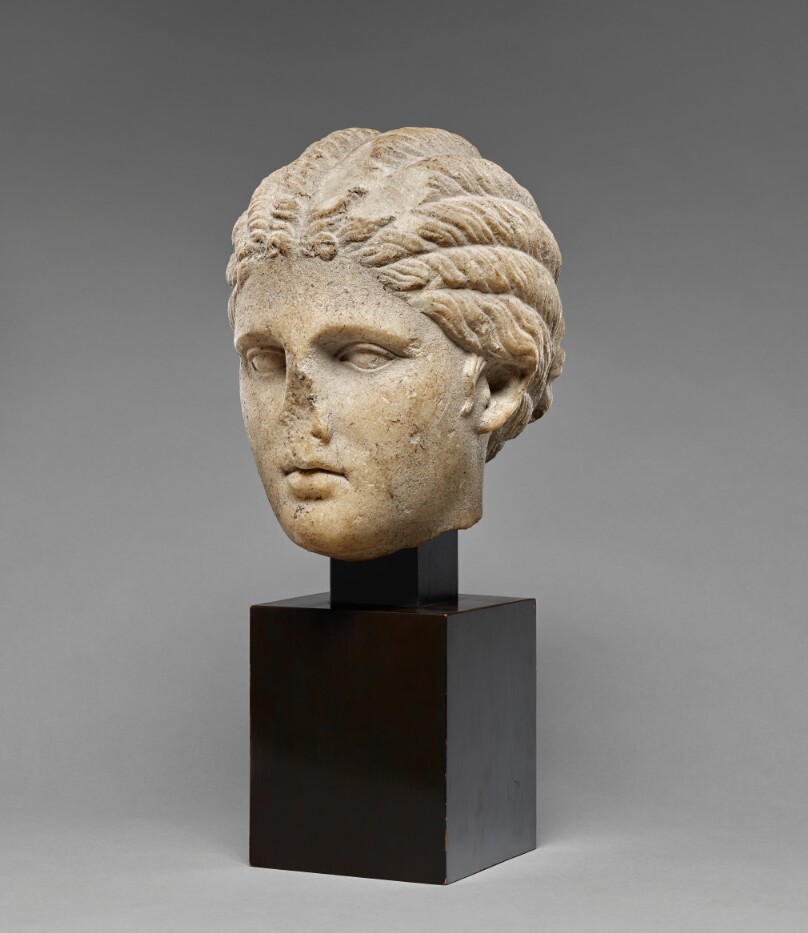
Head of a Young Woman (Small Herculaneum Woman type)
Creator
UnknownAll works by this person →More on Getty ULAN- Date
- 25 B.C.–A.D. 25
- Medium
- Marble
- Culture
- Roman
- Department
- Sculpture
- Institution
- Getty Museum
- Object ID
- 508ddd08-a62c-4df2-b1cf-27c6a7c79540
From the Getty Museum record
The head depicts a young woman with even and entirely symmetrical features. Her face is in the shape of an oval with a smooth forehead below a semicircular hairline and terminates in a small but perfectly rounded chin. Under gently arched brows her almond-shaped eyes, though missing any indication of irises or pupils, appear slightly downcast; her nose—from what is left of it—would have been slim; and the small mouth is softly embedded between the swelling flesh of her cheeks. The sensitive lips are slightly parted as if breathing or speaking. The idealized yet organic build of the face is crowned by a distinct hairstyle commonly referred to as a melon coiffure: the hair is divided into ten evenly spaced rows (“lobes”) running parallel from front to back. There they meet five additional rows starting from behind the ears and converge in a circular chignon whose center the sculptor left ill-defined. Each row is made up of diagonal strands of wavy hair; two lose S-shaped curls are decoratively pulled out before each ear; and above the forehead, the central part is accentuated by a pair of mirroring ring curls. The head belongs to a type in Greco-Roman sculpture known as the Small Herculaneum Woman, which is named after two draped statues in the Dresden State Art Museums (inv. [Hm 327][1] and [Hm 328][2]), that were discovered about 1711 at Herculaneum and were among the very first discoveries from the ancient city. This statue type of a draped woman is ubiquitous in Roman sculpture and was employed in the vast majority of cases to be equipped with individual contemporary portrait heads. Only three statues are known that preserve the draped body together with the Greek-style head featuring the melon coiffure. The image likely originated in Greek sculpture of the late 300s B.C.E. and may have represented a priestess, poet, civic benefactor—in her own right or as a family member of one—that was honored with a public statue. [1]: https://skd-online-collection.skd.museum/Details/Index/166437 [2]: https://skd-online-collection.skd.museum/Details/Index/166438
The authoritative record is held by Getty Museum. LinkedCulture surfaces this object and its connections; it does not alter institutional metadata.
Get printable QR codesHide QR codes
Open QR codes for this object page and the museum record. They stay collapsed until needed.
Related across collections
Semantically similar works from Getty Museum and other institutions.