Getty Museum
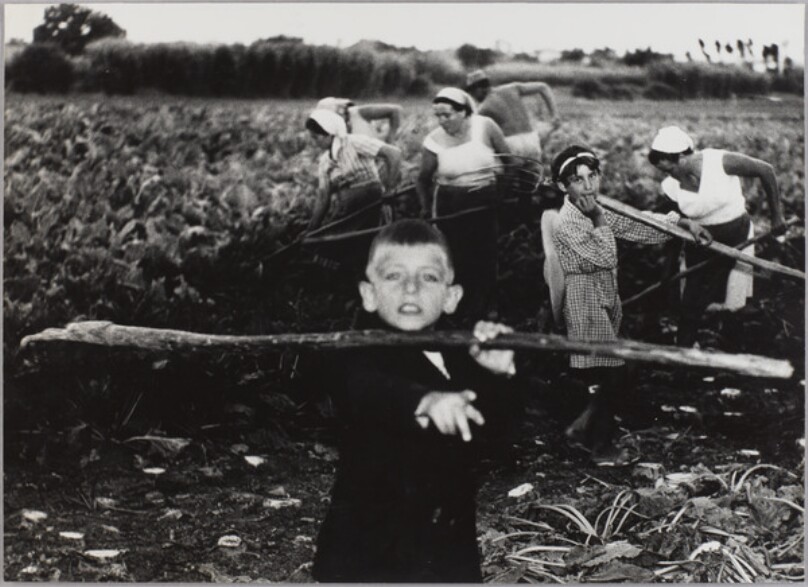
La buona terra
Creator
Mario GiacomelliItalian Photographer · 1925–2000
All works by this person →Mario Giacomelli (1925–2000) is widely recognized as one of the foremost Italian photographers of the twentieth century. Born into poverty, he lived his entire life in Senigallia, a town on the Adriatic coast, in the Marche region. After losing his father at age nine and completing elementary school at eleven, he apprenticed as a typesetter and printer, while also teaching himself to paint and wri
More on Getty ULAN- Date
- negative 1964–1966; print 1970s
- Medium
- Gelatin silver print
- Culture
- Italian
- Department
- Photographs
- Institution
- Getty Museum
- Object ID
- 577afdd4-2d90-4a34-9c82-0d3283fb353c
From the Getty Museum record
For this series, The Good Earth, Giacomelli followed a farming family off and on over several years as they went about their daily lives in the countryside surrounding Senigallia, planting and harvesting crops and tending livestock. Once he had gained their trust, he began to make photographs that underscored the cyclical nature of their existence, including both the intermingling of multiple generations and the interweaving of daily chores and responsibilities with moments of leisure and renewal. The Good Earth tells a story of resilience, self-sufficiency, and continuity. The last of these is symbolized by the recurring motif of towering haystacks that serve as the backdrop for work, play, and the celebration of a young couple’s wedding. See other examples of works from the series ([2016.179.4](http://www.getty.edu/art/collection/objects/297414/), [2016.179.6.1](http://www.getty.edu/art/collection/objects/297435/), [2016.179.6.2](http://www.getty.edu/art/collection/objects/297436/), [2016.179.6.4](http://www.getty.edu/art/collection/objects/297438/), [2016.179.6.8](http://www.getty.edu/art/collection/objects/297442/), [2016.179.6.15](http://www.getty.edu/art/collection/objects/297449/), [2016.179.49](http://www.getty.edu/art/collection/objects/297504/), [2021.3.1](http://www.getty.edu/art/collection/objects/350490/), [2021.3.2](http://www.getty.edu/art/collection/objects/350493/)). Periodically Giacomelli asked the family, with whom he maintained a friendship beyond this project, to use their tractor to plow patterns in fields that lay fallow. The resulting images, which form the basis of his series Awareness of Nature ([2016.179.5.2](http://www.getty.edu/art/collection/objects/297417), [2016.179.5.3](http://www.getty.edu/art/collection/objects/297418/), [2016.179.5.7](http://www.getty.edu/art/collection/objects/297422/), [2016.179.11](http://www.getty.edu/art/collection/objects/297458/), [2016.179.5.14](http://www.getty.edu/art/collection/objects/297429/), [2016.179.5.15](http://www.getty.edu/art/collection/objects/297430/), [2016.179.5.16](http://www.getty.edu/art/collection/objects/297431/), [2016.179.5.17](http://www.getty.edu/art/collection/objects/297432/), [2016.179.34](http://www.getty.edu/art/collection/objects/297483/), [2016.179.36](http://www.getty.edu/art/collection/objects/297485/), [2016.179.52](http://www.getty.edu/art/collection/objects/297509/), 2020.58), address the issue of humankind’s interventions in the landscape. Virginia Heckert, J. Paul Getty Museum, Department of Photographs 2021
The authoritative record is held by Getty Museum. LinkedCulture surfaces this object and its connections; it does not alter institutional metadata.
Get printable QR codesHide QR codes
Open QR codes for this object page and the museum record. They stay collapsed until needed.
Related across collections
Semantically similar works from Getty Museum and other institutions.