Getty Museum
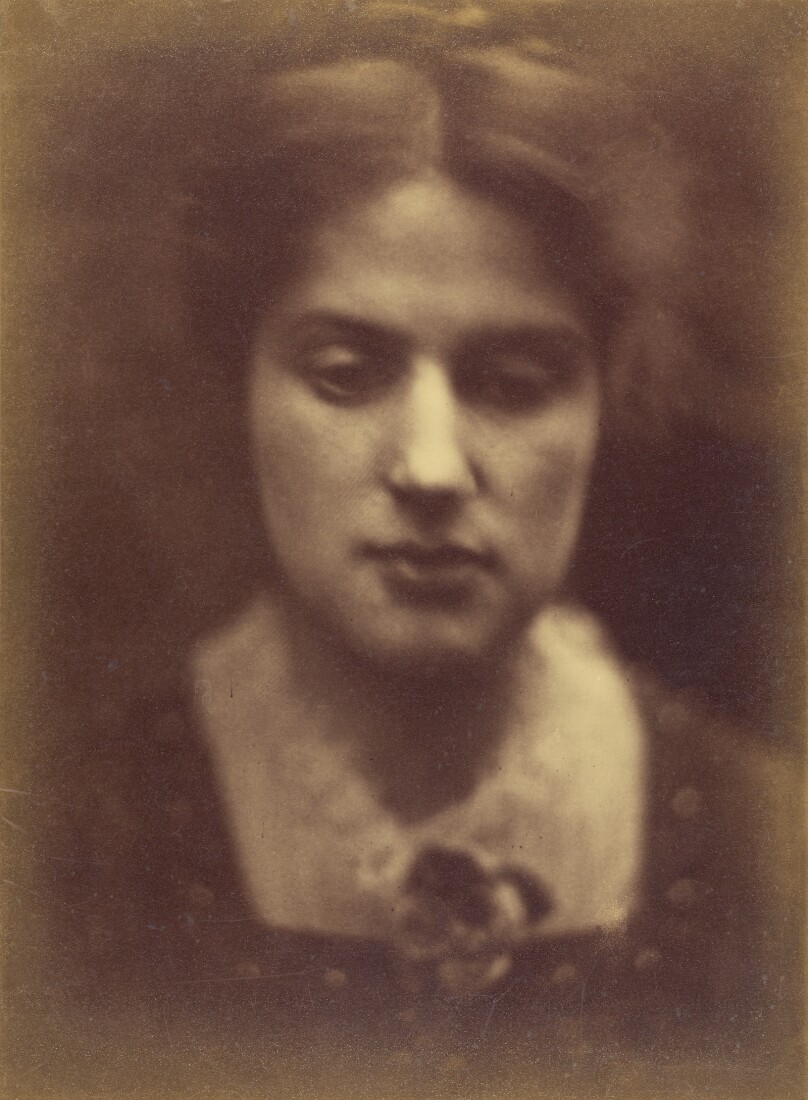
Marie Spartali
Creator
Julia Margaret CameronBritish Photographer · 1815–1879
All works by this person →After receiving a camera as a gift, Julia Margaret Cameron began her career in photography at the age of forty-eight. She produced the majority of her work from her home at Freshwater on the Isle of Wight. By the coercive force of her eccentric personality, she enlisted everyone around her as models, from family members to domestic servants and local residents. The wife of a retired jurist, Camero
More on Getty ULAN- Date
- 1870
- Medium
- Albumen silver print
- Culture
- British
- Department
- Photographs
- Institution
- Getty Museum
- Object ID
- 5b05e600-f741-4d4d-961c-b096ea9ef756
From the Getty Museum record
> Greek in heritage and British by birth, Marie Spartali (1844-1927) was the daughter of the Greek consul general in London. A sought-after model for her beauty, she posed for Dante Gabriel Rossetti, Edward Burne-Jones, and Ford Madox Brown. Spartali studied painting with Rossetti and Brown and developed a personal style that combined elements drawn from Renaissance art and contemporary culture. She used watercolor and gouache to obtain a soft-dreamlike quality in her work. Her work was exhibited with the Society of Female Artists in London, and shown at the Dudley Gallery, London, in 1867, the Royal Academy, London, in 1873, a gallery in Boston, Massachusetts, in 1873, and the 1878 Universal Exposition in Paris, among others. In 1871 she married William Stillman (1828-1901), an American journalist, photographer, and early follower of John Ruskin. > > Spartali’s father, who lived on the Isle of Wight, brought her to Julia Margaret Cameron to have her portrait made in 1867. Evidently, Cameron admired Spartali’s looks since she went on to photograph her on numerous occasions in the years 1867 to 1870 (see also [84.XM.443.33](https://www.getty.edu/art/collection/objects/58850/julia-margaret-cameron-marie-spartali-british-1870/) and [84.XM.443.35](https://www.getty.edu/art/collection/objects/58852/julia-margaret-cameron-marie-spartali-british-negative-1868-print-1870/)). Several studies of her, attired in period costume and assuming a historical identity, were registered for copyright in September 1868 and October 1870. Spartali was a public personality and a woman of independent standing, so her portrait was commercially viable. > > In this work Cameron models Spartali’s bust with a minimum of lighting, an unusual approach for the artist. This produces a virtuosic effect and a heightened relief akin to the sculpted head of a Roman goddess or matron. The camera is positioned slightly below the subject, which imparts an added strength and power to her visage. Rossetti wrote of Spartali in August 1869: “I find her head the most difficult I ever drew. It depends not nearly so much on real form as on a subtle charm of life which one cannot re-create. I think it would be hardly possible to make a completely successful picture of her.” This remark provides some measure of Cameron’s achievement with this portrait. > > Adapted from Julian Cox. *Julia Margaret Cameron*, In Focus: From the J. Paul Getty Museum (Los Angeles: J. Paul Getty Museum, 1996), 80. ©1996 The J. Paul Getty Museum. For more information about Marie Spartali see: Frederick, Margaretta S. and Marsh, Jan. *Poetry in Beauty: The Pre-Raphaelite Art of Marie Spartali Stillman.* (Wilmington, Delaware: Delaware Art Museum, 2015).
The authoritative record is held by Getty Museum. LinkedCulture surfaces this object and its connections; it does not alter institutional metadata.
Get printable QR codesHide QR codes
Open QR codes for this object page and the museum record. They stay collapsed until needed.
Related across collections
Semantically similar works from Getty Museum and other institutions.