Getty Museum
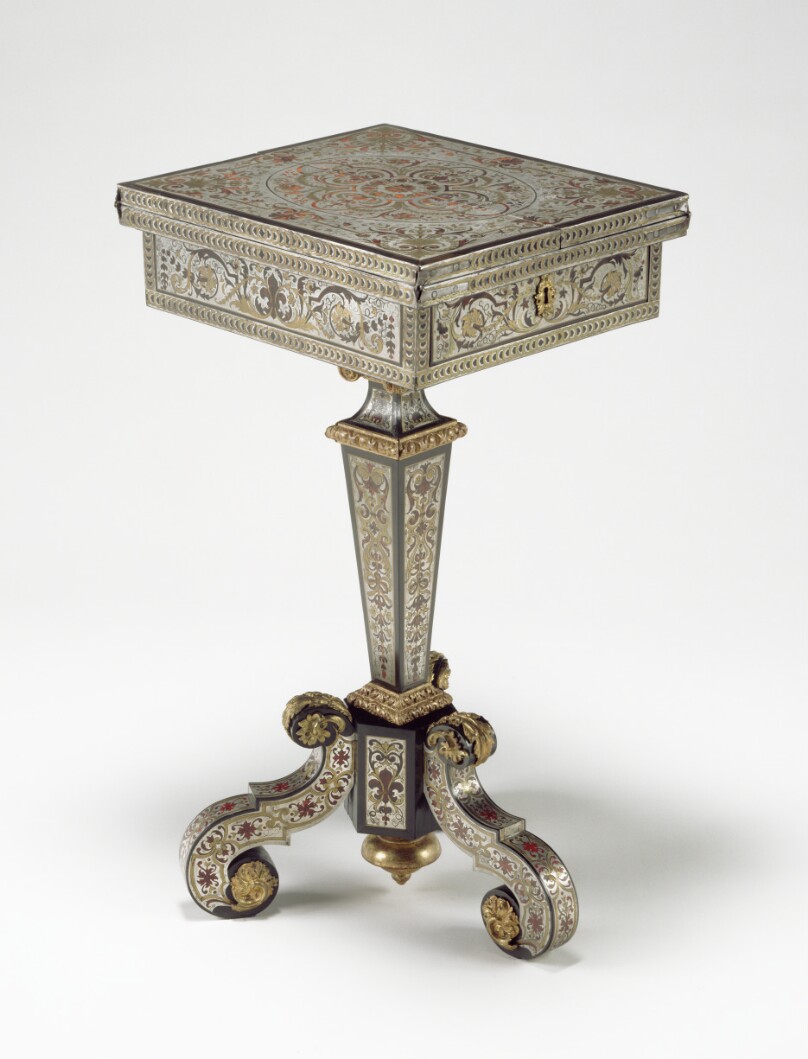
Tripod table
Creator
Pierre GoleFrench Artist · 1620–1684
All works by this person →The second son of a bailiff, Pierre Golle was born in Holland but moved to Paris at an early age. He first worked as an apprentice to an *ébéniste* who specialized in ebony furniture, then later married his master's daughter and took over the workshop. A connection by marriage to the architect and engraver Jean Marot, who worked for Louis XIV, king of France, may have led to Golle's first royal co
More on Getty ULAN- Date
- about 1680
- Medium
- Oak veneered with brass, pewter, tortoise shell, walnut, and ebony, with drawers of oak and rosewood; gilded fruitwood; gilt-bronze mounts
- Culture
- French
- Department
- Decorative Arts
- Institution
- Getty Museum
- Object ID
- 5eb2a1bb-eb01-4208-a1ee-58fc99fcc0c4
From the Getty Museum record
The top of this small table folds open, revealing a circular scene of three women dressed in exotic costumes and taking tea under the pulled-back curtains of a tent. A monkey and a parrot perch in the branches of trees blossoming in the background. The marquetry tea scene and the table's sturdy tripod form suggest this table was used to support a tea or coffee tray. Veneered with pewter and brass, the table's major decorative elements are made of tortoiseshell; this form of decoration is known as *contre partie.* The table was probably made for the Grand Dauphin, the oldest son of Louis XIV, King of France. It prominently displays five fleurs-de-lis, the heraldic lily from the royal arms of France, and four dolphins, symbol of the Dauphin. At this date royal emblems appeared only on royal gifts or on objects made for members of the royal family.
The authoritative record is held by Getty Museum. LinkedCulture surfaces this object and its connections; it does not alter institutional metadata.
Get printable QR codesHide QR codes
Open QR codes for this object page and the museum record. They stay collapsed until needed.
Related across collections
Semantically similar works from Getty Museum and other institutions.