Getty Museum
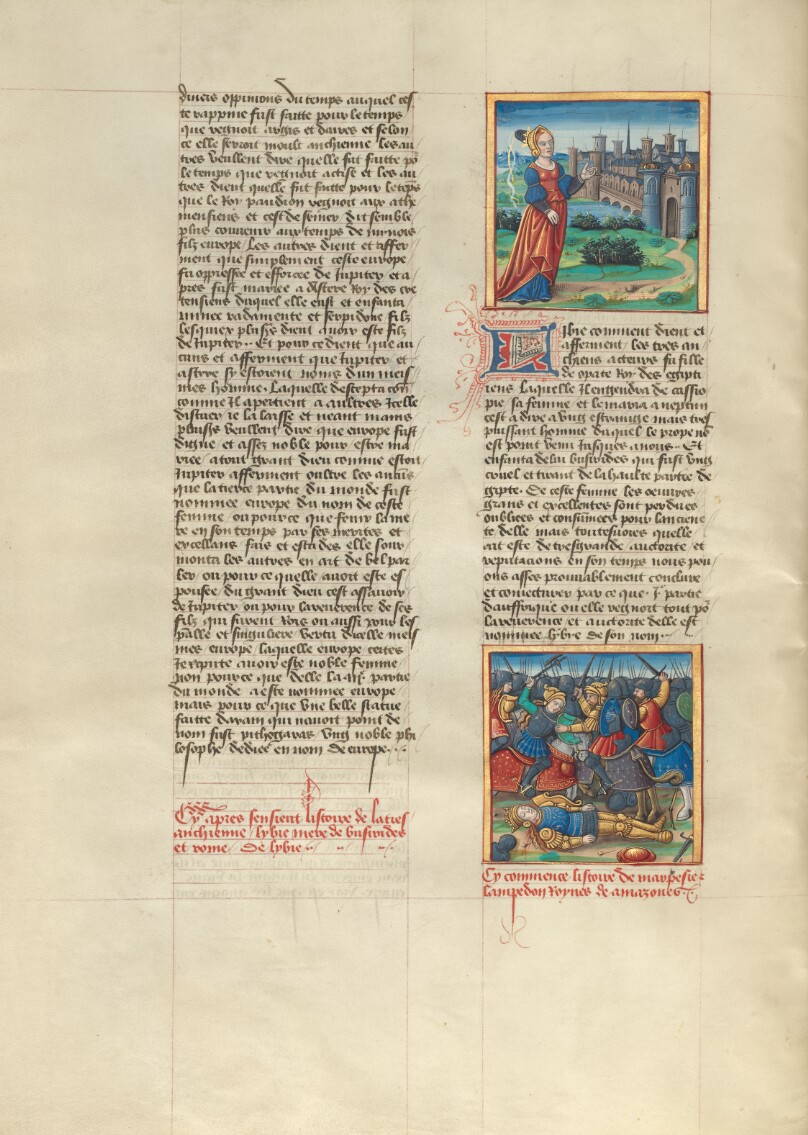
Libya, Queen of Libya, Gesturing to Her Kingdom; The Death of Marpesia, Queen of the Amazons
- Date
- about 1450–1475, illumination added about 1515–1520
- Medium
- Tempera colors, gold, and ink
- Culture
- French
- Department
- Manuscripts
- Institution
- Getty Museum
- Object ID
- 686aeeda-adfb-4c9d-86e2-d95a4991107d
From the Getty Museum record
The mythological queen of the African country named after her, Libya, towers in the foreground of a lush landscape, gesturing to a large citadel. The French illuminator Étienne Colaud modelled the representation of the city on images of European towns from his own time. Despite her African origins, Libya is depicted as a wealthy sixteenth-century European lady, wearing a long gown with a rounded neckline and puffed sleeves and a variation of a French hood capped with a crown and a cascading ribbon. Women are no strangers to battle in Boccaccio’s compendium of famous women’s biographies. According to the text, the mythical society of women warriors known as the Amazons led many campaigns against the forces of Europe and Asia, surpassing the deeds of many eminent military men. The sisters Marpesia and Lampedo, legendary queens and warriors among the Amazons, ruled together to ensure that one of them was always able to defend the homeland while the other conquered enemies and expanded the empire abroad. It was during one of these battles that Marpesia, characterized by Boccaccio as overconfident, was slain. Her body, clad in gold and azure armor, lies prone on the battlefield, the war still raging in the background. One Amazonian lifts her halberd against an enemy who attempts to seize her shield while preparing to bring his sword down.
The authoritative record is held by Getty Museum. LinkedCulture surfaces this object and its connections; it does not alter institutional metadata.
Get printable QR codesHide QR codes
Open QR codes for this object page and the museum record. They stay collapsed until needed.
Related across collections
Semantically similar works from Getty Museum and other institutions.